On every statewide USDA measure, Michigan hunting land costs less than Ohio’s. Michigan farm real estate averaged $7,000 an acre in 2026; Ohio’s was $9,650. Ohio’s name for bigger bucks is earned, and the state’s own harvest data shows it. Michigan counters with more public land, big northern woods Ohio can’t match, and a one-buck rule for the Lower Peninsula that begins with the 2027 season.
USDA doesn’t track hunting land separately, so read those numbers as a statewide benchmark for farm ground. Hunting parcels sell on their own terms. We’re Michigan Whitetail Properties, an independent Michigan brokerage that has worked all 83 counties since 1995, and we built this comparison for buyers stuck choosing between the two states.
Key takeaways
- USDA’s 2026 averages: Michigan farm real estate $7,000 an acre (up 2.9%), Ohio $9,650 (up 3.2%). For cropland it’s $6,600 in Michigan and $10,100 in Ohio.
- A nonresident buck license costs $171 in Michigan and $399.36 in Ohio.
- Ohio limits every hunter to one antlered deer a season. Michigan’s Lower Peninsula goes to one buck per hunter with the 2027 seasons; in 2026 a combo license still allows two.
- Michigan’s DNR manages about 4.6 million acres of public land. In Ohio, the DNR says public land is roughly 4% of the state.
- Right at the state line, the 2022 Census had Hillsdale and Lenawee farmland at $5,493 to $5,766 an acre, while the Ohio counties next door ran $7,565 to $8,863.
The Side-by-Side Comparison
 Michigan rules below come from the DNR’s 2026 deer regulations. Ohio figures come from Ohio DNR’s 2026–27 hunting regulations and its Summer 2026 deer summary, read Oct. 19, 2026.
| Michigan | Ohio | |
|---|---|---|
| Farm real estate, average per acre (USDA, 2026) | $7,000 (+2.9%) | $9,650 (+3.2%) |
| Cropland, average per acre (USDA, 2026) | $6,600 (+3.9%) | $10,100 (+3.6%) |
| Pasture, average per acre (USDA, 2026) | $3,200 (+3.2%) | $4,250 (+2.4%) |
| Farm size, average and median (2022 Census of Agriculture) | 208 and 50 acres | 180 and 53 acres |
| Public land | About 4.6 million acres managed by the DNR, plus more than 2.2 million acres of Commercial Forest open to public foot hunting | Roughly 4% of the state’s land area |
| Resident license for one buck | $31 (base $11 + single deer $20) | $50.20 (hunting license $19 + either-sex permit $31.20) |
| Nonresident license for one buck | $171 ($151 + $20); $341 with the deer combo | $399.36 ($180.96 + $218.40) |
| Antlered deer per hunter | Up to two in 2026 with a combo license; one in the Lower Peninsula from 2027 | One per season, statewide |
| Antler point restrictions | Vary by deer management unit; four-point minimum on the combo’s restricted tag | None found in the 2026–27 rules; an antlered deer has one antler 3 inches or longer |
| Main firearm season | Nov. 15–30, 2026 | Nov. 30–Dec. 6 and Dec. 19–20, 2026 |
| Archery | Oct. 1–Nov. 14 and Dec. 1, 2026–Jan. 1, 2027 | Sept. 26, 2026–Feb. 7, 2027 |
| CWD in wild deer | Confirmed in 18 counties since 2015 | First found in December 2020; the surveillance area covers all of Allen, Hardin, Marion and Wyandot counties and parts of five more |
We left deer density out because neither DNR publishes a statewide figure we could compare. Michigan also dropped its rifle line this year, so every legal firearm is allowed across the Lower Peninsula; our rifle line explainer covers what that changes.
Ohio farm real estate averages $2,650 more per acre than Michigan’s (USDA, 2026). On 100 acres, that’s $265,000.
Ohio’s Real Advantage, Stated Honestly
 Ohio’s buck numbers are strong and well documented. Ohio hunters took 99,008 bucks in 2025–26, the second-largest buck harvest in state history, behind 100,766 the season before. Ohio DNR reports that nearly one-third of the antlered deer it aged during gun season were 3.5 years or older. Before the mid-2000s, fewer than 15% were. Half of Ohio’s adult resident deer permit buyers took at least one deer last season.
A lot of hunting talk gives Ohio’s one-buck limit the credit. Ohio DNR’s own summary doesn’t. It says the older age structure is likely due to hunter selectivity and liberal antlerless opportunities: with plenty of does to fill the freezer, hunters could afford to pass young bucks. Keep that in mind before you bet on a rule change alone.
Geography favors Ohio for many buyers, too. Its top nonresident states by harvest last season were Pennsylvania, Michigan, North Carolina, Florida and New York; Michigan hunters took 1,868 Ohio deer.
You pay for it: Ohio land values are higher on every USDA line, and its nonresident buck license costs more than twice Michigan’s.
Where Michigan Wins
 Acreage per dollar is the plainest case. At USDA’s 2026 averages, $1 million buys about 143 acres of Michigan farm real estate or about 104 acres in Ohio.
Public land is where Michigan pulls furthest ahead. The DNR manages about 4.6 million acres of public land, and more than 2.2 million acres of privately owned Commercial Forest land are open to public foot traffic for hunting, fishing and trapping. Ohio DNR says public land makes up roughly 4% of Ohio. Its own data shows the gap in results: 49% of Ohio’s private-land deer hunters took a deer last season, against 18% on public land.
The north adds ground Ohio doesn’t have. The 2022 Census of Agriculture valued farmland at $2,348 an acre in Alger County in the Upper Peninsula, $3,069 in Alcona County and $3,467 in Houghton County. Ohio’s statewide figure was $8,043. There isn’t much farmland up there, so take those numbers as a rough guide. Plenty of buyers head north for lake and river frontage as well, though no public dataset puts a price on it.
The 2027 Convergence Story
 Under rules the Natural Resources Commission approved on May 13, 2026, Lower Peninsula hunters get one buck each starting with the 2027 deer seasons. Nothing changes in the Upper Peninsula for 2027. Nothing changes on bucks in 2026: a combo license still allows two antlered deer. See our one-buck rule guide and the earn-a-second-buck pilot for the details.
By 2027, most hunters in both states will be capped at one buck. Ohio already has a long record of older bucks in its harvest; the Lower Peninsula hasn’t hunted a season under the rule yet.
The argument for buying now is timing. Land bought in 2026 is bought before any effect of the rule shows up in harvest data or prices. The argument against is Ohio’s own evidence: its DNR credits hunter selectivity and liberal antlerless opportunities for its older bucks, so a buck limit by itself proves nothing. If Lower Peninsula hunters start passing young bucks the way Ohio hunters have, the reputation gap could narrow. Nobody has Michigan data on that yet.
Non-Resident Economics
 For an out-of-state buyer, the license bill is the one recurring cost you can compare cleanly. Here it is over ten years at today’s prices.
| Nonresident costs | Michigan | Ohio |
|---|---|---|
| One buck tag, one year | $171 | $399.36 |
| Ten years at 2026 prices | $1,710 | $3,993.60 |
| Two-buck option (2026) | $341 with the deer combo | Not available; one antlered deer limit |
| 100 acres at USDA’s 2026 farm real estate average | $700,000 | $965,000 |
Fees change: Michigan’s base license runs through March 31, 2027, and Ohio’s license year runs March 1 to the end of February. Property taxes are left out because they depend on the township and parcel; Michigan Treasury’s property tax estimator gives a local figure.
What out-of-state buyers tend to miss:
- Owning Michigan land doesn’t make you a Michigan resident for licenses. You’ll pay nonresident prices.
- Hunt Ohio too? Coming home, Michigan only allows deboned meat, quarters without the spine or head, hides, finished mounts and cleaned antlers or skull caps.
- How long the drive takes depends on your starting point, so map the route to the counties you’re looking at.
For everything else in the process, see our out-of-state buyer’s guide.
Which Michigan Counties Compete Directly With Ohio’s Best
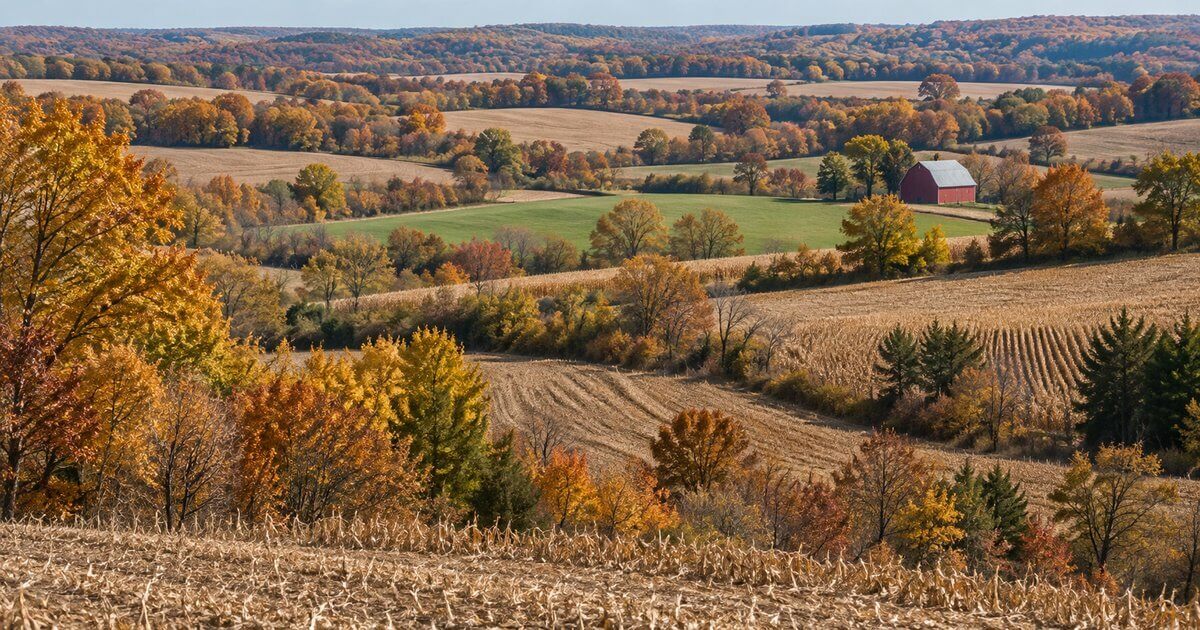 Michigan’s southern tier is the closest match to Ohio farm country. Hillsdale and Lenawee counties sit on the Ohio line, and Branch, Jackson and Calhoun counties sit just north and west of them, with the same mix of crop fields and woodlots.
| County | Value of land and buildings per acre (2022 Census of Agriculture) | Average farm size |
|---|---|---|
| Hillsdale, MI (borders Ohio) | $5,493 | 230 acres |
| Lenawee, MI (borders Ohio) | $5,766 | 272 acres |
| Branch, MI | $5,315 | 294 acres |
| Jackson, MI | $4,952 | 198 acres |
| Calhoun, MI | $5,072 | 227 acres |
| Williams, OH (borders Hillsdale) | $7,565 | 289 acres |
| Fulton, OH (borders Hillsdale and Lenawee) | $7,946 | 266 acres |
| Lucas, OH (borders Lenawee) | $8,863 | 209 acres |
These are 2022 values for farmland with its buildings, the latest county figures USDA publishes.
One qualifier: Ohio’s top counties for nonresident harvest last season (Meigs, Adams, Athens, Pike and Gallia) are in the southeastern hills, and their 2022 Census values ran $3,625 to $5,254 an acre. The big price gap is with Ohio’s farm belt.
Before buying in the southern tier, know that Hillsdale and Jackson are on Michigan’s list of 18 counties with CWD found in wild deer. Our CWD guide for buyers and sellers explains what that means for a property.