Michigan land prices per acre in 2026 range from approximately $1,200 per acre in the remote Upper Peninsula to $15,000 or more per acre in high-demand southern Michigan counties — a spread that reflects the state’s remarkable geographic and economic diversity. Across the northern Lower Peninsula, hunting and timber parcels in counties like Oscoda, Montmorency, and Presque Isle have been trading between $1,800 and $4,500 per acre, with waterfront and AuSable River-adjacent parcels commanding significant premiums above that range. The Michigan Association of REALTORS® reported that rural land values across the state appreciated an average of 7–9% annually over the 2021–2025 period, driven by strong buyer demand from both hunters and out-of-state investors. At Michigan Whitetail Properties, we track active listing data and closed sales across all 83 Michigan counties, and 2026 is shaping up to be another competitive year for quality land — especially in the $150,000–$400,000 range where inventory remains tight.
You’re watching from Ohio or Illinois or wherever you’re parked right now, running the math on whether Michigan land still pencils out. Maybe you bought something Up North five years ago and it’s already worth 35% more than what you paid. Or maybe you’ve been sitting on the sidelines waiting for prices to soften.
Here’s what we can tell you after three decades of walking Michigan ground: the softening hasn’t come in the good counties, and it’s not coming soon. What has changed is the spread between regions. If you understand that spread — county by county — you can still find genuine value in 2026. Let’s walk through the numbers.
What Drives Michigan Land Prices: The Fundamentals
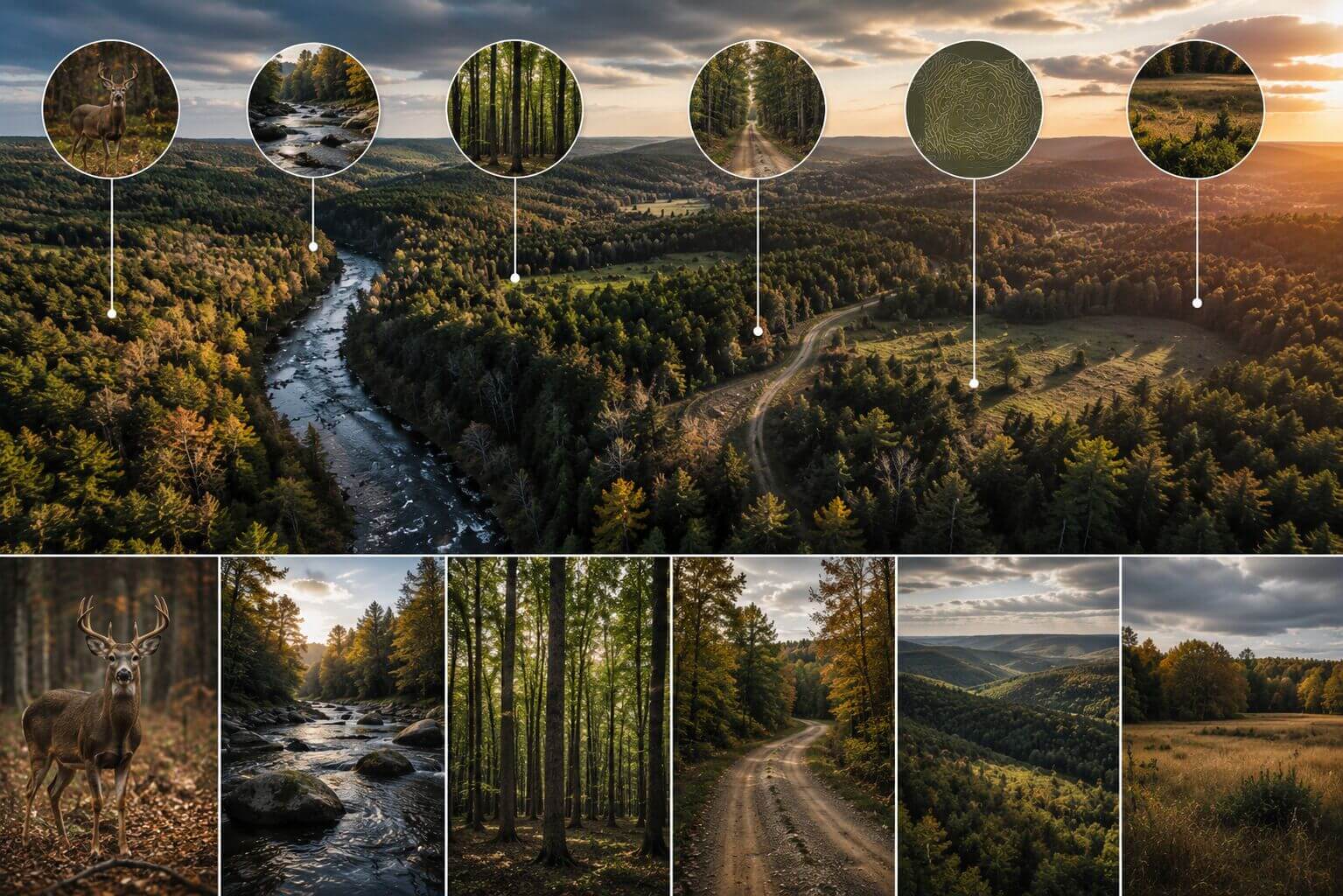 Before you compare county pricing, you need to understand what moves the needle on land value in Michigan. It’s not one thing — it’s a combination of factors that stack differently in every county.
Deer density and hunting pressure are the biggest drivers in the northern Lower Peninsula and UP hunting land market. Per the Michigan DNR’s 2024 deer harvest report, counties like Montmorency, Oscoda, and Presque Isle consistently rank among the top 10 in Lower Peninsula antlered buck harvest, and buyers price that reputation into the land. A 120-acre hardwood parcel in Montmorency County will sell for more than a comparable parcel in a county with lower hunting pressure — even if the timber value is identical.
Waterfront and creek access add a 20–40% premium in most northern Michigan counties. AuSable River frontage, access to inland lakes in Roscommon County, or shoreline on Lake Michigan or Lake Huron can push per-acre values well above county averages. We’ve seen otherwise unremarkable 40-acre parcels with 300 feet of lake frontage trade at prices that would shock a buyer used to looking at landlocked ground.
Road access and infrastructure matter more than most out-of-state buyers expect. Landlocked parcels accessible only by two-track or seasonal road sell at a discount — sometimes 30–50% below parcels with paved or maintained gravel access. That discount can be your opportunity if you have the patience and the right vehicle, but go in with eyes open.
Timber value plays a supporting role in the northern Lower Peninsula and a much larger role in the UP. A standing timber cruise on a mature hardwood or pine parcel can account for $500–$1,500 per acre in embedded value. Always order a timber cruise before buying any timbered parcel over 40 acres.
Northern Lower Peninsula: The Sweet Spot for Hunting Land Buyers
 The northern Lower Peninsula — roughly everything north of a line from Cadillac to West Branch — is where Michigan Whitetail Properties does the majority of our business, and it’s where we have the deepest market data.
The five counties that generate the most buyer inquiries in our office are Oscoda, Montmorency, Presque Isle, Ogemaw, and Roscommon. Here’s how pricing is stacking up in 2026:
The table below summarizes current average price-per-acre ranges based on active listing data and recent closed sales as tracked by Michigan Whitetail Properties (April 2026). These ranges reflect landlocked, undeveloped hunting and timber parcels in the 40–200 acre size range. Waterfront, improved, or smaller parcels will trade above these ranges.
| County | Avg. Price/Acre Range | Key Strengths | Notable Premium Factors |
|---|---|---|---|
| Oscoda County | $1,800 – $3,200 | AuSable River corridor, Huron National Forest adjacency, top deer county | River frontage +30–40% |
| Montmorency County | $2,000 – $3,800 | Highest deer density in LP, Thunder Bay River headwaters | Buck hunting reputation +20% |
| Presque Isle County | $1,600 – $3,000 | Remote, low hunting pressure, Lake Huron access | Waterfront +35–50% |
| Ogemaw County | $2,200 – $4,200 | West Branch area, mix of timber and ag, easy access | Ag ground +25% |
| Roscommon County | $2,800 – $5,500 | Houghton Lake, Higgins Lake, tourism market overlap | Lakefront +40–60% |
Ogemaw and Roscommon have ticked up noticeably since 2023 — the proximity to population centers and dual-use (hunting + cabin) appeal is driving that premium. Oscoda County remains the best pure value in the northern LP for a serious deer hunter who wants maximum acres per dollar. Browse current hunting land listings in Oscoda County to see what’s available right now.
Upper Peninsula Pricing: Value for the Patient Buyer
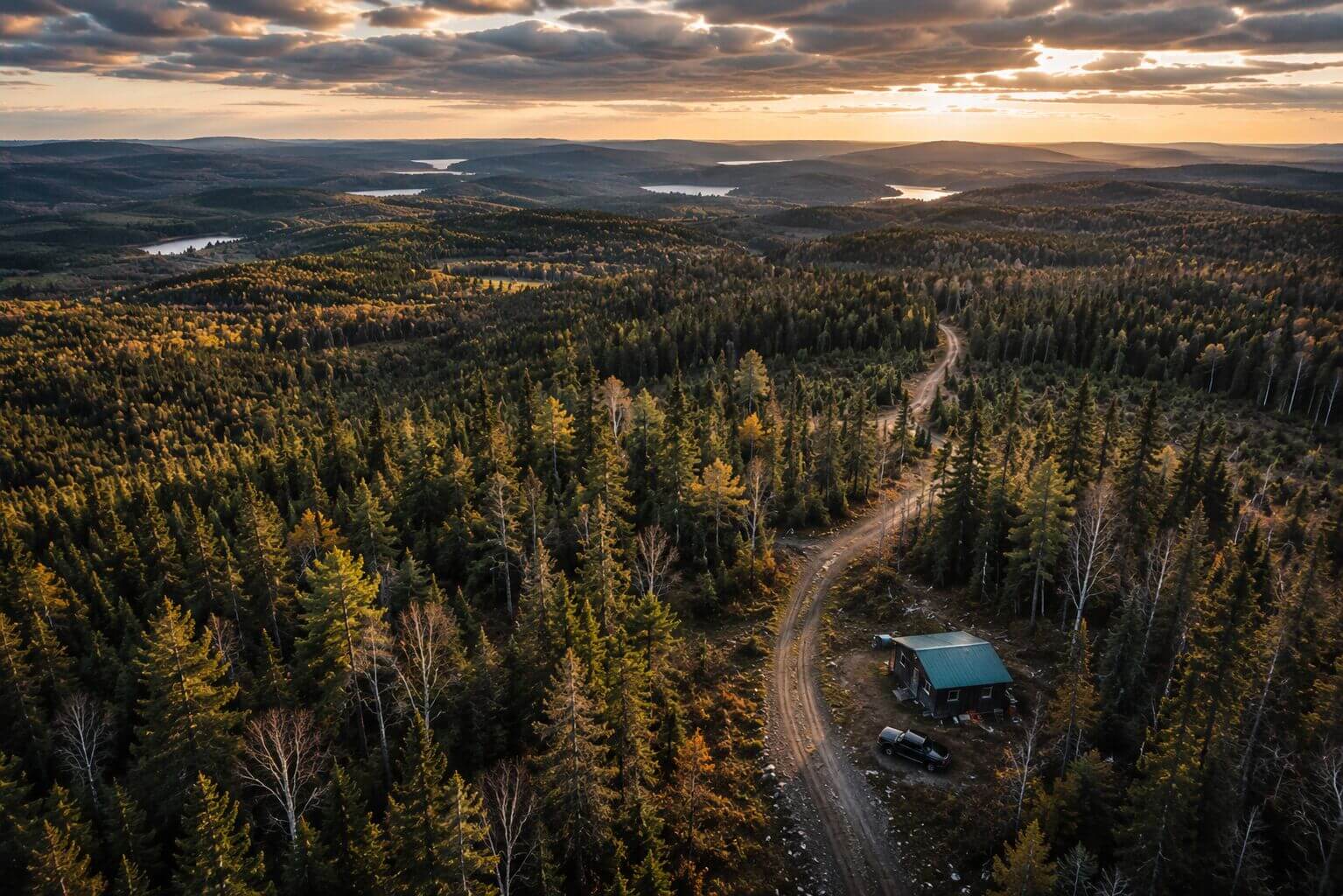 The UP is a different animal. Land prices in the Upper Peninsula average $1,200–$2,800 per acre for undeveloped timber and hunting ground, with remote counties like Ontonagon, Gogebic, and Baraga offering parcels under $1,500 per acre — a price point that’s become increasingly rare in the Lower Peninsula.
What the UP Offers
The tradeoff is infrastructure and accessibility. A 160-acre parcel in Baraga County at $1,300 per acre might be an hour from the nearest paved road and another hour from the nearest town with a hardware store. That’s not a dealbreaker for the right buyer — it’s a feature. But out-of-state buyers sometimes underestimate the logistics of owning and maintaining UP property from a distance.
UP Counties Worth Watching in 2026
Marquette and Chippewa counties are the most liquid UP markets, meaning you can sell when you want to sell. They’ve seen the strongest appreciation — averaging 5–8% annually since 2020, per USDA land value surveys — because they offer a combination of accessibility and commodity-grade timber value. Mackinac County, bridging the UP and the straits area, has been seeing increased buyer activity from Lower Peninsula buyers who want remote feel without a six-hour drive from Detroit.
Southern Michigan: High Values, Different Buyer Profile
Southern Michigan — Hillsdale, Jackson, Calhoun, Allegan, Barry, and similar counties — operates in a different market entirely. Farm ground and productive agricultural parcels in these counties have been trading at $6,000–$14,000 per acre, according to Michigan Association of REALTORS® farm land sale data for 2024–2025. Prime tillable ground in Lenawee or Hillsdale County has hit $15,000 per acre at auction.
The buyer profile here shifts from hunters to investors and farmers. Cash-rent returns on southern Michigan tillable ground have been running $200–$280 per acre annually in productive areas, according to MSU Extension’s 2024 Michigan Cash Rent Survey — a 3–4% cap rate on agricultural assets that still competes favorably with other inflation-resistant asset classes.
If hunting is your primary motivation, southern Michigan doesn’t offer the best dollar-per-deer-opportunity value. But if you want appreciating agricultural land that also supports turkey, pheasant, and some whitetail hunting? Hillsdale and Allegan counties deserve a serious look.
Land Price Trends: Michigan vs. the Midwest
Michigan hunting and rural land has outperformed most comparable Midwest markets over the past five years. The USDA’s 2024 Land Values Summary showed Michigan farmland values up 8% year-over-year — stronger than Indiana (6%) and Ohio (5%), though trailing Iowa’s corn-belt-driven numbers.
For hunting land specifically — which doesn’t always track with farmland surveys — the anecdotal and listing-data picture at Michigan Whitetail Properties suggests appreciation in the 7–12% range annually for quality hunting parcels in the northern Lower Peninsula since 2020. A $150,000 parcel in 2020 is worth roughly $220,000–$250,000 today if it was quality timber and deer ground in a strong county.
Several factors support continued appreciation:
- Michigan’s land inventory isn’t growing. Quality hunting parcels are a finite resource, particularly those adjacent to state forest land.
- Remote work has permanently expanded the buyer pool. Buyers who need to be in the office five days a week have been replaced by buyers who only need to be there two — which puts them within weekend range of properties they’d have dismissed before 2020.
- Inventory remains historically tight in the $200,000–$400,000 price range, where the most active hunter-buyer segment competes.
Note: Michigan Whitetail Properties provides market information for educational purposes. We are not financial advisors. Past appreciation is not a guarantee of future performance. Consult a qualified financial advisor before making investment decisions.
How to Use County Price Data When You’re Shopping
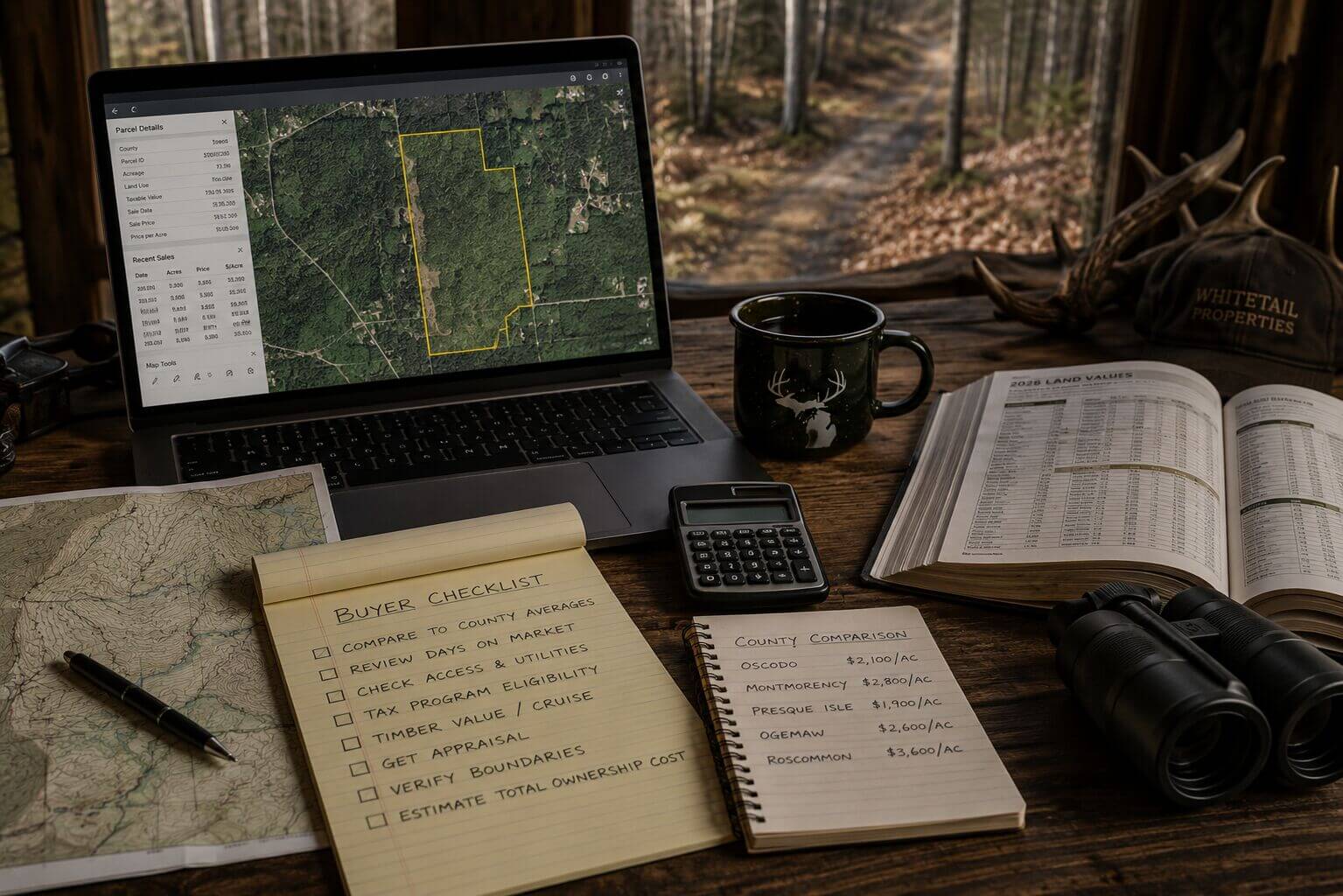 Raw per-acre numbers are useful, but they’re just the starting point. Here’s how to use them intelligently when you’re evaluating a specific property.
Always compare the listed price against the county average for similar-sized parcels in the same use category. A 120-acre parcel offered at $3,800 per acre in Oscoda County is priced above the average — which doesn’t mean it’s overpriced, but you need a reason. Is there a river frontage premium? Exceptional deer habitat? Timber value that was recently cruised? If the premium isn’t explained, ask.
Pay attention to days on market. Properties sitting at 120–180+ days in a county where quality land typically moves in 30–60 days are either overpriced or have a problem that isn’t obvious in the listing. Both of those situations can be opportunities — if you know what you’re buying.
Also factor in tax reduction programs before you finalize your cost-of-ownership math. Michigan’s Qualified Forest Program alone can save buyers $800–$2,500 annually on qualifying parcels — a number that changes what you can realistically afford. Finally, get a current land appraisal on anything over $200,000. A certified appraiser familiar with Michigan hunting land markets is worth every dollar of their fee. The county equalization values that show up in tax records often lag actual market values by 12–18 months, so don’t mistake a low assessed value for a data point about what the land is actually worth.
Michigan Hunting Land Price Per Acre by County — 2026 Data Table
| County | Region | Est. Price/Acre (2026) | Land Character | Hunting Quality | Notes |
|---|---|---|---|---|---|
| Alcona | NE Lower Pen. | $4,993 – $7,000 | Remote timber/recreational | ★★★★ | Most affordable in NLP; active deer and turkey; Huron NF adjacency |
| Oscoda | NE Lower Pen. | $8,000 – $10,500 | Timber/recreational | ★★★★ | High market activity (271% turnover); Au Sable River corridor |
| Crawford | NE Lower Pen. | $7,500 – $9,500 | Timber/recreational | ★★★★ | Au Sable River; strong deer and turkey; 200% market turnover |
| Montmorency | NE Lower Pen. | $8,500 – $11,500 | Timber/recreational | ★★★★★ | Top whitetail county; Thunder Bay River; 260% market turnover |
| Alpena | NE Lower Pen. | $9,500 – $13,000 | Mix farm/timber | ★★★★ | Fastest avg. days-on-market in state (~59 days) |
| Presque Isle | NE Lower Pen. | $8,000 – $12,000 | Timber/recreational | ★★★★ | Remote character; strong deer and salmon/steelhead rivers |
| Cheboygan | NE Lower Pen. | $12,000 – $17,000 | Mix farm/timber/water | ★★★★ | Fast market (~85 days DOM); Inland Waterway access; cash rent $27/acre |
| Otsego | NE Lower Pen. | $10,000 – $14,000 | Timber/recreational | ★★★★ | Gaylord corridor; food plot potential; solid deer numbers |
| Iosco | NE Lower Pen. | $8,000 – $12,000 | Timber/water | ★★★ | Au Sable mouth area; waterfront premium applies on river parcels |
| Kalkaska | NW Lower Pen. | $12,000 – $16,000 | Timber/agricultural | ★★★★ | Balanced farm/timber; strong deer and turkey habitat |
| Wexford | NW Lower Pen. | $12,000 – $16,000 | Timber/agricultural | ★★★★ | Cadillac area; reasonable entry before NW resort premium kicks in |
| Missaukee | NW Lower Pen. | $11,000 – $15,000 | Agricultural/timber | ★★★★ | Lake City area; food plot potential; underrated hunting county |
| Manistee | NW Lower Pen. | $14,000 – $20,000 | Timber/water | ★★★ | Manistee River; mix of timber and waterfront-influenced pricing |
| Antrim | NW Lower Pen. | $18,000 – $28,000 | Mixed rec/resort | ★★★ | Lake Bellaire/Elk Lake area; resort premium starting to run pricing |
| Grand Traverse | NW Lower Pen. | $55,000 – $82,000+ | Resort/suburban | ★★ | Traverse City metro premium; limited pure hunting land available |
| Charlevoix | NW Lower Pen. | $35,000 – $58,000+ | Resort/waterfront | ★★ | Resort market dominates; verify parcel character before assuming huntability |
| Emmet | NW Lower Pen. | $40,000 – $60,000 | Resort/waterfront | ★★ | Petoskey area; waterfront drives pricing; hunting land limited |
| Leelanau | NW Lower Pen. | $50,000 – $62,000+ | Resort/wine country | ★ | Extreme resort premium; effectively not a hunting land market |
| Roscommon | Central | $15,000 – $18,500 | Recreational/water | ★★★ | Houghton Lake area; high demand (269% turnover); lake premium present |
| Lake | West Central | $11,500 – $14,500 | Timber/recreational | ★★★★★ | Top investment value statewide; 32.3% appreciation; strong deer |
| Mecosta | West Central | $16,000 – $21,000 | Mix farm/timber | ★★★★ | Solid hunting land to ag transition; Big Rapids area |
| Montcalm | West Central | $10,000 – $13,500 | Mix farm/timber | ★★★★ | 24.4% appreciation rate; affordable entry with strong growth trajectory |
| Newaygo | West Central | $17,000 – $22,000 | Timber/agricultural | ★★★★ | Muskegon River; solid deer; good food plot ground |
| Osceola | West Central | $13,000 – $17,000 | Timber/agricultural | ★★★★ | Reed City area; underrated county; affordable mid-Michigan timber |
| Clare | Central | $13,000 – $17,000 | Timber/recreational | ★★★★ | Strong deer numbers; accessible pricing; 111-day avg. DOM |
| Gladwin | Central | $14,000 – $18,000 | Timber/agricultural | ★★★★ | Tittabawassee River; mixed farm/timber; consistent buyer demand |
| Ogemaw | Central | $11,500 – $16,000 | Timber/recreational | ★★★★ | Rose City area; reliable deer habitat; reasonable entry price |
| Arenac | E. Central | $13,000 – $17,000 | Mix farm/timber | ★★★ | Saginaw Bay fringe; waterfowl plus deer; transitional character |
| Midland | E. Central | $24,000 – $35,000 | Suburban/agricultural | ★★ | Development pressure dominant; limited pure hunting land character |
| Isabella | E. Central | $20,000 – $30,000 | Agricultural | ★★ | Mt. Pleasant area; mostly cropland with limited timber |
| Allegan | SW Lower Pen. | $45,000 – $55,000 | Mix farm/timber | ★★★ | SW Michigan premium; quality hunting but expensive entry |
| Barry | SW Lower Pen. | $28,000 – $36,000 | Mix farm/timber | ★★★★ | Underrated hunting county; food plot potential; 167% market turnover |
| Calhoun | SW Lower Pen. | $22,000 – $30,000 | Agricultural/suburban | ★★★ | Battle Creek metro influence; mix of farm and timber parcels |
| Branch | SW Lower Pen. | $20,000 – $26,000 | Agricultural | ★★★★ | More affordable SW entry; strong agriculture-hunting crossover |
| St. Joseph | SW Lower Pen. | $20,000 – $26,000 | Agricultural | ★★★ | Good food source land; mid-range entry for southern Michigan hunters |
| Van Buren | SW Lower Pen. | $25,000 – $35,000 | Mix farm/timber | ★★★ | SW premium; some excellent mixed timber parcels available |
| Berrien | SW Lower Pen. | $28,000 – $40,000 | Agricultural/lakeshore | ★★ | Lake Michigan premium dominant; limited pure hunting ground |
| Kalamazoo | SW Lower Pen. | $55,000 – $68,000 | Suburban/agricultural | ★★ | Urban premium runs pricing; limited hunting land available |
| Hillsdale | SE Lower Pen. | $10,000 – $18,000 | Mix farm/timber | ★★★★★ | Best value in southern Michigan; 253% market turnover; exceptional deer |
| Lenawee | SE Lower Pen. | $25,000 – $32,000 | Agricultural | ★★★ | Cash rent $176/acre; strong ag-hunting crossover; 90% turnover |
| Jackson | SE Lower Pen. | $22,000 – $32,000 | Mixed | ★★★ | Slow market (285 days DOM); buyer leverage available with patience |
| Monroe | SE Lower Pen. | $22,000 – $30,000 | Agricultural | ★★★ | Cash rent $164/acre; Saginaw corridor deer potential |
| Livingston | SE Lower Pen. | $40,000 – $55,000 | Suburban/agricultural | ★★ | Detroit exurban premium; limited pure hunting character |
| Washtenaw | SE Lower Pen. | $45,000 – $52,000 | Suburban/agricultural | ★★ | Ann Arbor premium; not a hunting land market in practical terms |
| Huron | Thumb | $30,000 – $38,000 | Agricultural | ★★★ | Top cash rent in state ($237/acre); cropland character; slow market |
| Gratiot | Thumb/Central | $40,000 – $45,000 | Agricultural | ★★★ | Highly productive farmland; cash rent $199/acre; Thumb character |
| Tuscola | Thumb | $28,000 – $36,000 | Agricultural | ★★★ | Thumb ag character; deer in the fencerows and woodlots |
| Sanilac | Thumb | $25,000 – $32,000 | Agricultural | ★★★ | Similar Thumb character to Tuscola and Huron; ag-dominated |
| Ontonagon | Upper Pen. | $6,000 – $8,500 | Remote timber | ★★★★ | Highest appreciation in state (46.2%); Ottawa National Forest adjacency |
| Gogebic | Upper Pen. | $8,000 – $11,000 | Timber/remote | ★★★★ | Ottawa NF adjacency; good bear and deer; affordable UP entry |
| Iron | Upper Pen. | $9,000 – $12,000 | Timber/remote | ★★★ | Rugged ground; trophy potential; road access the critical variable |
| Baraga | Upper Pen. | $9,000 – $13,000 | Timber/remote | ★★★★ | High market activity (293% turnover); Keweenaw Bay |
| Keweenaw | Upper Pen. | $9,000 – $13,000 | Remote timber | ★★★ | 600% market turnover — scarcest inventory in the state |
| Luce | Upper Pen. | $7,000 – $11,000 | Remote timber | ★★★★ | 700% turnover — fastest-selling county in Michigan; act quickly |
| Chippewa | Upper Pen. | $8,000 – $12,000 | Timber/agricultural | ★★★★ | Sault area; mix of timber and some agricultural ground |
| Schoolcraft | Upper Pen. | $7,500 – $11,000 | Remote timber | ★★★★ | Seney National Wildlife Refuge adjacency; solid deer habitat |
| Alger | Upper Pen. | $8,000 – $12,000 | Timber/water | ★★★ | Pictured Rocks adjacency; tourism premium near lakeshore |
| Marquette | Upper Pen. | $11,000 – $16,000 | Timber/mixed | ★★★ | Largest UP county; Marquette city influence; strong timber character |
| Mackinac | Upper Pen. | $10,000 – $14,000 | Timber/remote | ★★★★ | Straits area; bridge access; solid deer and bear population |
| Dickinson | Upper Pen. | $10,000 – $14,000 | Timber/mixed | ★★★ | Iron Mountain area; some development influence on pricing |
| Menominee | Upper Pen. | $10,000 – $14,000 | Timber/agricultural | ★★★ | Border county; mix of timber and Green Bay corridor ag ground |
| Delta | Upper Pen. | $10,000 – $14,000 | Timber/mixed | ★★★ | Escanaba area; Lake Michigan access adds some value influence |
| Houghton | Upper Pen. | $10,000 – $15,000 | Timber/mixed | ★★★ | Keweenaw Peninsula; copper country history; solid timber character |