Michigan One Buck Rule Passes: What Lower Peninsula Hunters and Land Buyers Need to Know
Last Updated: May 14, 2026
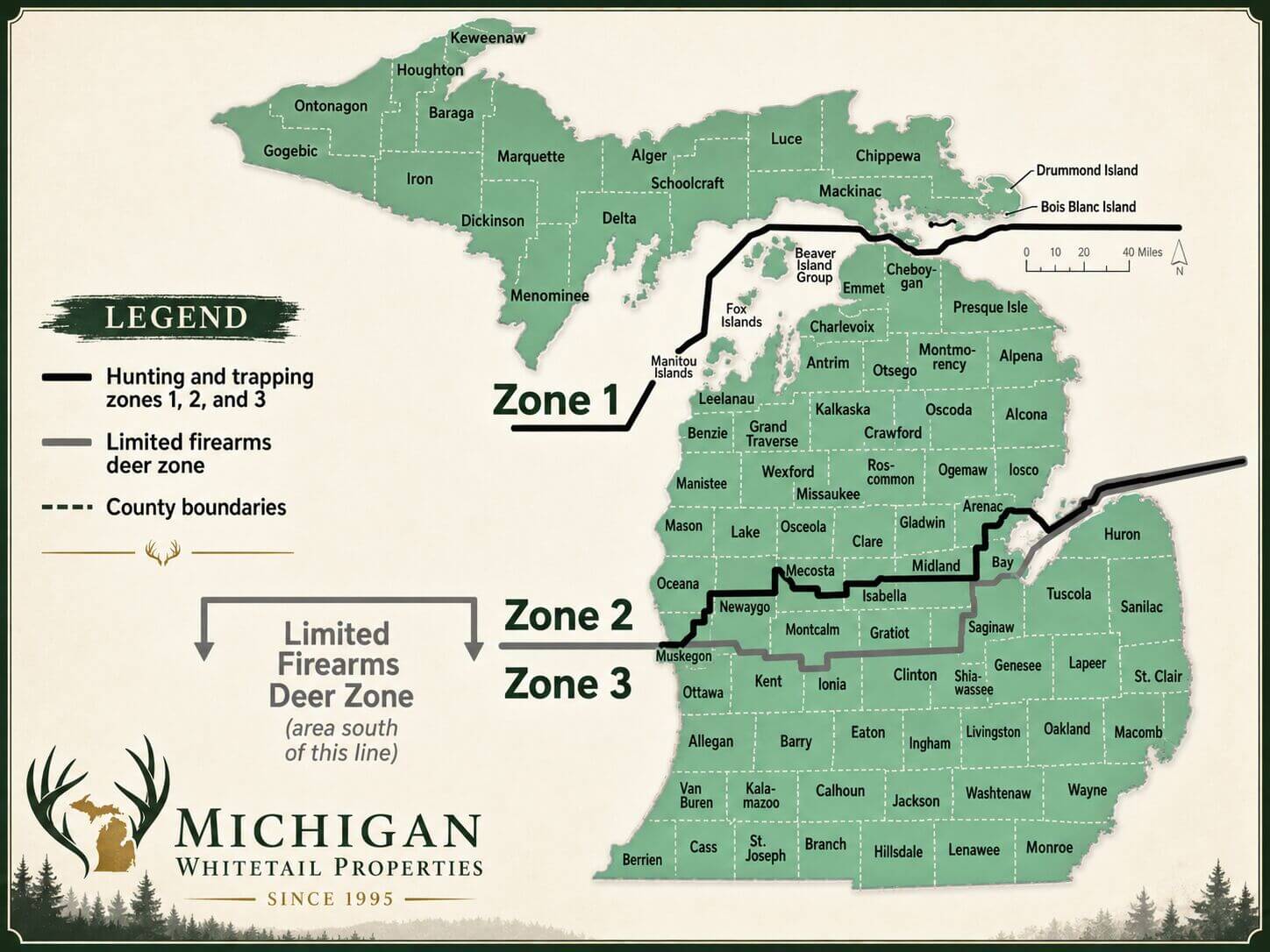 Michigan’s one buck rule is a Lower Peninsula deer regulation change that limits hunters to one antlered buck per season beginning March 1, 2027, after the Michigan Natural Resources Commission vote on May 13, 2026. The rule reduces the prior opportunity for some hunters to take two antlered bucks and is designed to shift pressure away from young bucks, encourage more antlerless harvest, and improve buck-to-doe balance over time. At the same meeting, the NRC also eliminated the limited firearm deer zone — the old “rifle line” — for the 2026 deer season. For Michigan hunters, this changes tag strategy.
For Michigan land buyers, it changes how we evaluate managed hunting ground, especially properties with documented mature buck activity, food plots, bedding cover, and lower surrounding pressure. Michigan Whitetail Properties has watched regulation changes shape hunting land demand across all 83 Michigan counties since 1995, and this one matters most for Lower Peninsula buyers looking at counties like Hillsdale, Lenawee, Tuscola, Lapeer, and Monroe.
Here’s what you need to understand about Michigan’s one buck rule: it was never really just about one buck.
It was about years of pressure on the same age class of deer. Go stand in a Tuscola County woodlot on a late October morning and watch what comes through. A lot of the bucks are 1.5- and 2.5-year-old deer — teenagers, by whitetail standards. They’re exciting to see, and nobody is blaming hunters for taking legal deer. But when enough young bucks get removed every season, year after year, the age structure never has much room to build.
That’s the real debate. Not whether Michigan hunters deserve opportunity. They do. The question is whether the Lower Peninsula can grow more mature deer if hunters become more selective and more antlerless harvest gets worked into the system.
The NRC voted yes. Here’s what hunters, buyers, and sellers need to know now.
What Michigan’s One Buck Rule Changes for Lower Peninsula Hunters
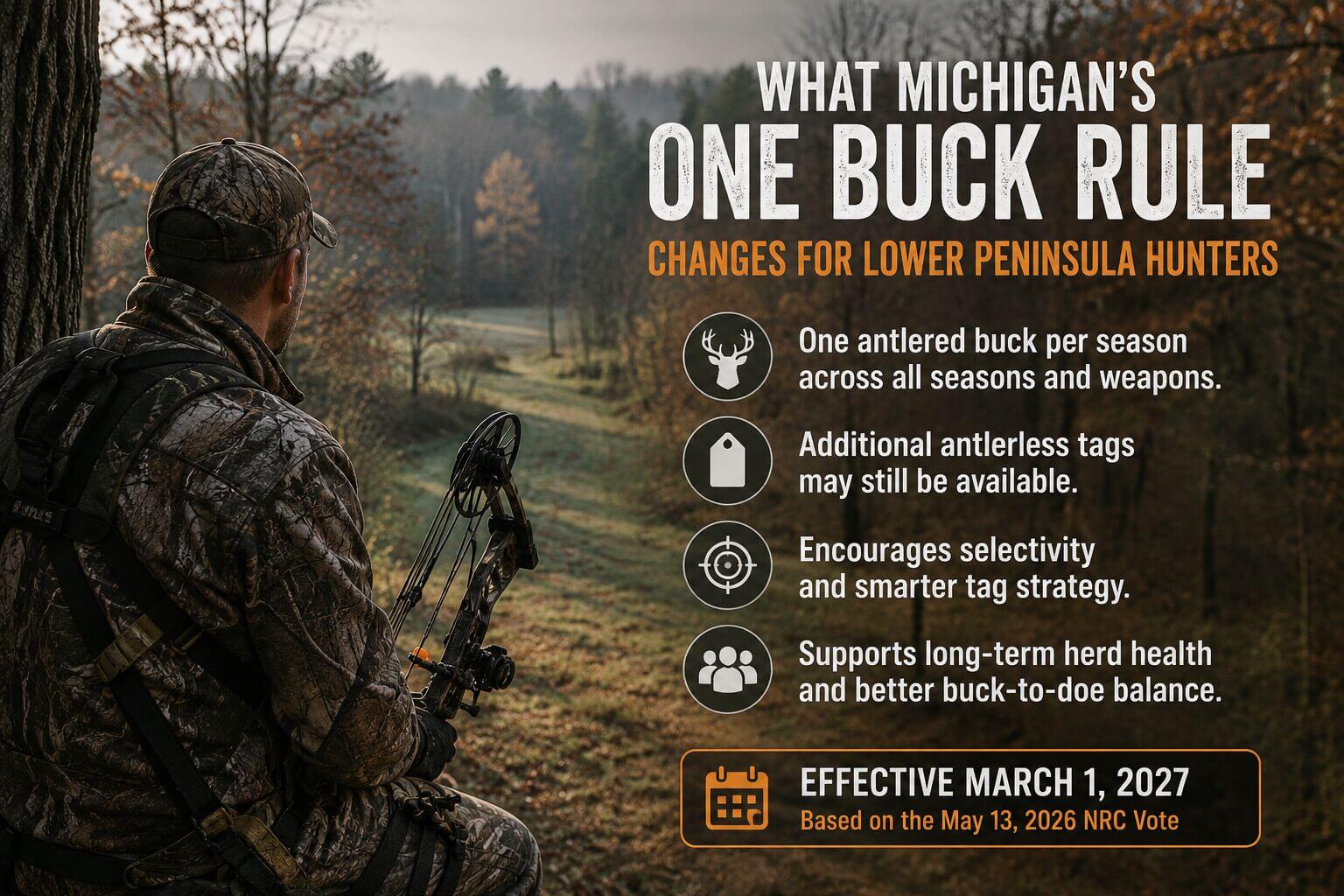 Michigan’s one buck rule changes how Lower Peninsula deer hunters manage their buck opportunity across the season. Instead of treating archery, firearm, and muzzleloader seasons as separate chances at antlered deer, hunters now have to think about the whole year as one buck decision.
The practical effect is simple: if you take an antlered buck, that is your buck for the season. Additional antlerless tags can still be purchased where available, but the antlered buck side of the equation tightens.
That changes behavior.
A hunter sitting over a scrape line in Jackson County on October 28 may think twice before shooting a 1.5-year-old eight-point. A firearm hunter in Lenawee County may decide to pass a young buck opening morning and fill an antlerless tag instead. A landowner in Lapeer County who has been trying to get neighbors on the same page suddenly has a regulation that supports that management conversation.
The rule does not magically create mature bucks overnight. It does create a framework where more young bucks have a chance to survive into the next age class.
That’s the whole point.
According to the Michigan DNR’s Wildlife Conservation Order Amendment No. 6 of 2026, about 4–7% of antlered deer harvested over the past decade — an average of just under 32,000 antlered deer statewide — were a second antlered deer taken by the same hunter. The DNR also noted that antlered deer harvest has exceeded antlerless harvest by an average of more than 52,000 deer statewide over the past five years.
Those numbers explain why this rule passed. Michigan has had a buck-heavy harvest culture for a long time. The one buck rule is an attempt to rebalance that.
What the NRC Voted on May 13, 2026
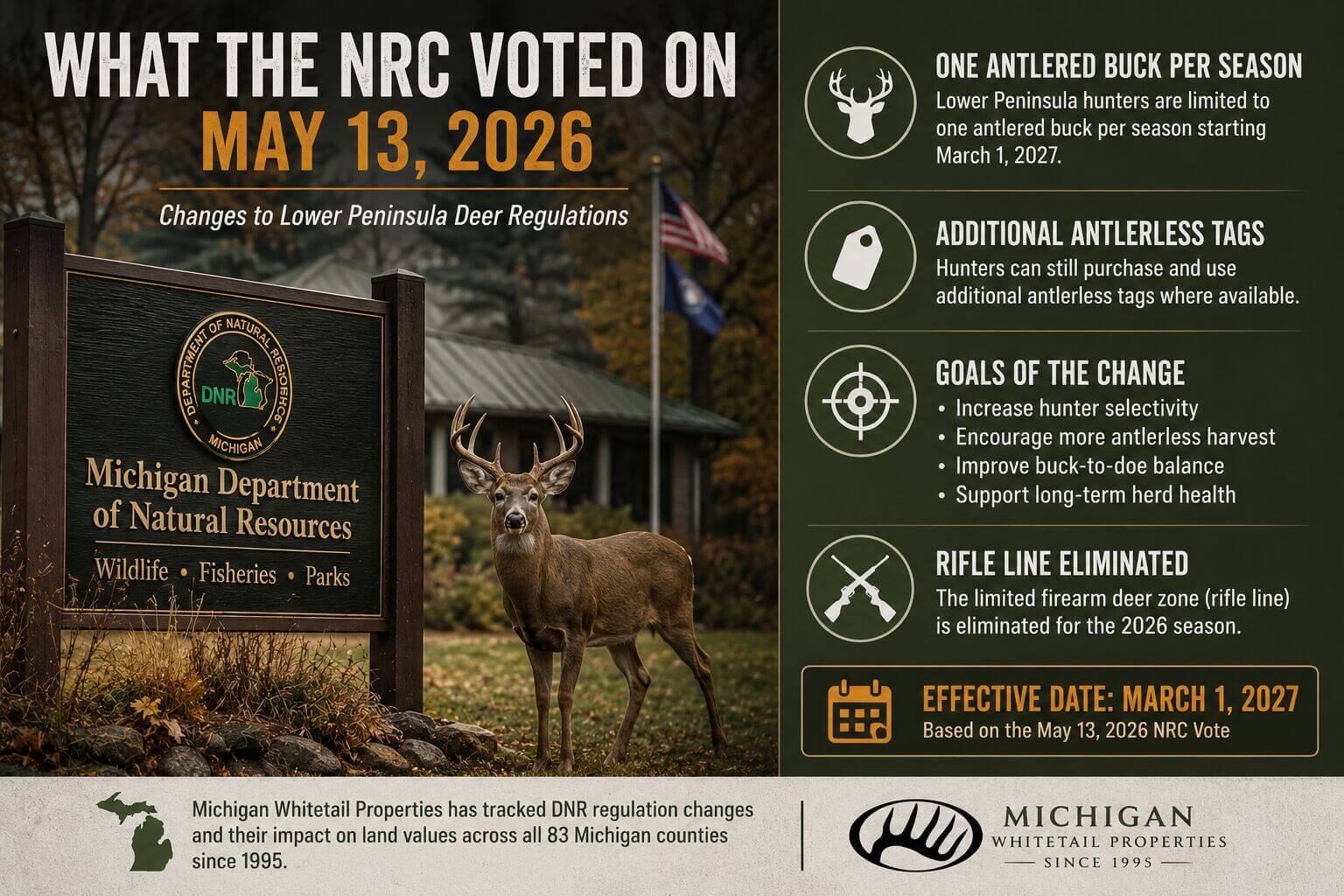 The Michigan Natural Resources Commission voted on May 13, 2026, to limit Lower Peninsula hunters to one antlered buck per season beginning with the 2027 hunting season. The change affects the way buck tags function in the Lower Peninsula and is tied directly to the DNR’s stated goal of increasing selectivity and pushing more harvest toward antlerless deer.
Under the updated framework, a Lower Peninsula hunter with a single deer license can still use that license on either an antlered or antlerless deer. But once that hunter takes an antlered buck, they are done hunting bucks for the season.
The deer combination license also changes in practical importance. In the Lower Peninsula, hunters can still use the regular tag under the available options, but the restricted tag and single deer license structure now pushes more opportunity toward antlerless harvest. The DNR’s materials explain that nearly 80% of Michigan hunters still do not harvest an antlerless deer in a given year, even though antlerless options already exist in many places.
That’s the hill the DNR is trying to climb.
The NRC also eliminated the limited firearm deer zone for the 2026 season. That zone — often called the rifle line — divided the Lower Peninsula by firearm restrictions and was originally tied to safety concerns in more populated southern counties. With that line removed, Lower Peninsula hunters will need to pay close attention to the final 2026 regulation digest before heading into firearm season.
One important distinction: this article is focused on the Lower Peninsula rule package and its land-market impact. The Upper Peninsula remains a different deer market with different habitat, winter severity, deer density, and buyer expectations.
How Michigan’s One Buck Rule Could Affect Whitetail Herds
Michigan’s one buck rule could improve buck age structure over time, but the impact will likely be gradual rather than immediate. The first season after the rule takes effect will not suddenly fill every trail camera with 4.5-year-old bucks. Deer herds don’t work that way.
But small changes compound.
When fewer young bucks are harvested, more of them reach the next season. A buck that survives from 1.5 to 2.5 years old is a different animal. A buck that survives to 3.5 or 4.5 years old changes the way a property hunts. He uses cover differently. He moves with more caution. He responds to pressure differently. He also becomes the kind of deer that makes a buyer pay close attention when trail camera photos come out at the kitchen table.
The DNR’s own materials call the immediate biological impact “modest,” but also note that greater changes would be expected over time as hunters adapt and antlerless harvest increases. That’s the right way to think about this rule. Not magic. Management.
We’ve walked plenty of Michigan properties where the habitat could grow older bucks, but the neighborhood pressure never allowed it. A 40-acre parcel with great bedding cover can produce pictures. A 160-acre parcel with bedding, food, water, access control, and cooperative neighbors can produce history.
There’s a difference.
The one buck rule gives more properties a chance to move from pictures to history, but the land still has to do its part.
How Michigan’s One Buck Rule Could Affect Michigan Hunting Land Values
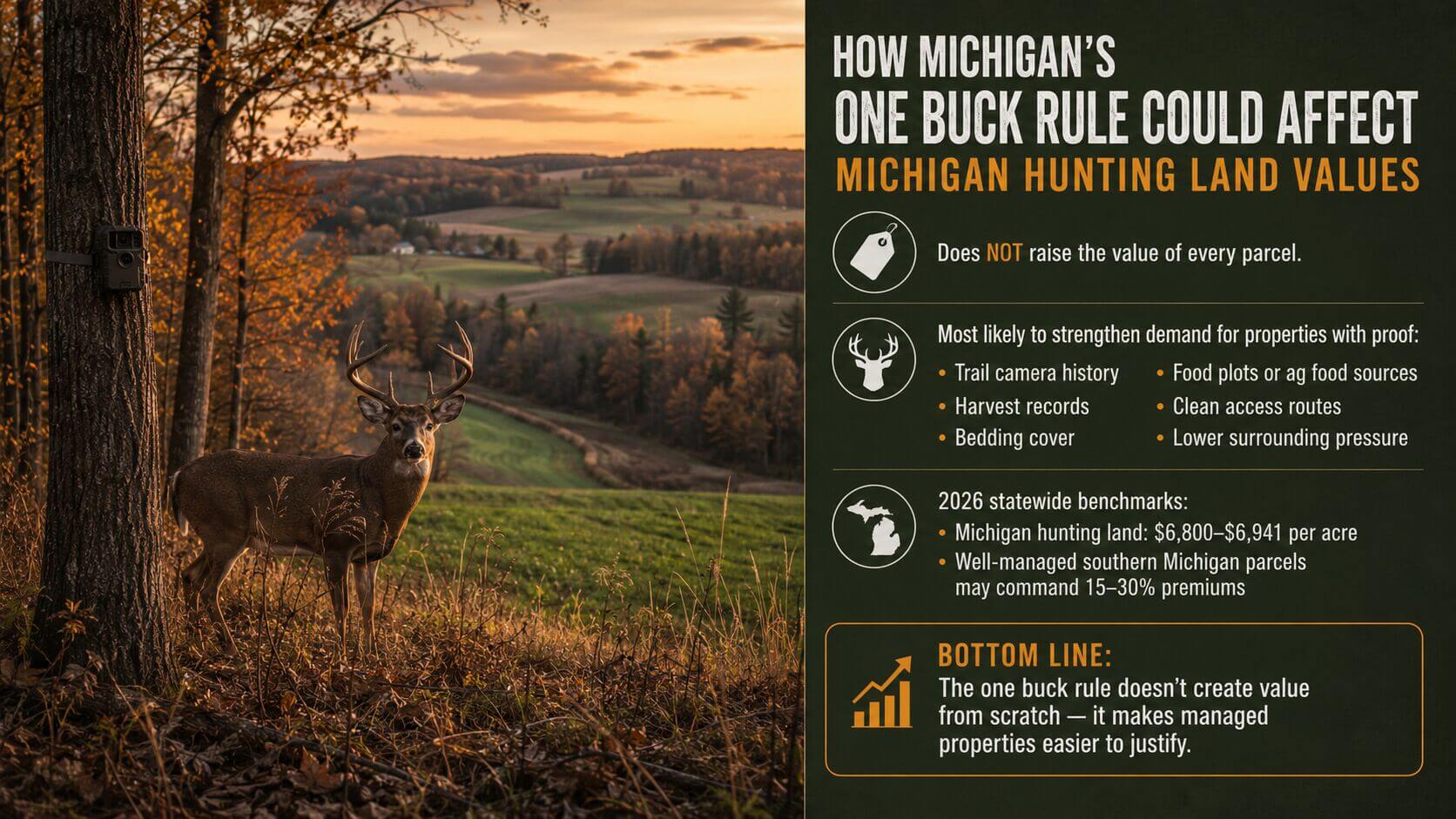 Michigan’s one buck rule will not raise the value of every hunting parcel in the Lower Peninsula. It will likely strengthen demand for properties that already have the ingredients to produce and hold mature bucks.
That’s the key distinction.
A thin 20-acre parcel with heavy road frontage, no bedding cover, and pressure on all four sides does not suddenly become a premium deer property because the rule changed. The regulation may help the broader deer herd, but buyers still pay for the ground in front of them.
The properties most likely to benefit are the ones with proof:
- Trail camera history showing older age-class bucks
- Harvest records showing restraint and management
- Bedding cover that deer can use without being bumped
- Food plot infrastructure or nearby agricultural food sources
- Water, timber diversity, creek bottoms, oak ridges, or cedar cover
- Access routes that let hunters enter and exit without blowing up the property
- Neighboring landowners who are also selective, or at least not applying extreme pressure
USDA NASS reports Michigan farm real estate averaged $7,000 per acre in 2026, up 2.9%; USDA does not survey hunting land separately. In parts of southern Michigan, we’ve seen well-managed parcels with documented buck quality command meaningful premiums above the local baseline, sometimes in the 15–30% range depending on acreage, improvements, access, and proof.
The one buck rule does not create that premium from scratch. It makes the argument easier to understand.
If two properties are both 80 acres in Hillsdale County, but one has five years of trail camera history, planted food plots, screened access, and documented mature buck use, that property should not be priced the same as unmanaged ground with no records. Buyers know the difference. So do we. For statewide value benchmarks, see Michigan land prices per acre in 2026.
Which Michigan Counties May Benefit Most Under the One Buck Rule
The Michigan counties most likely to see stronger buyer interest under the one buck rule are Lower Peninsula counties with agriculture, cover, deer numbers, and a track record of producing quality bucks. The rule applies broadly, but not every county starts from the same place.
Southeast Michigan: The Strongest Premium Tier
Hillsdale, Lenawee, Monroe, Jackson, and Washtenaw counties already sit in one of Michigan’s strongest hunting land corridors. These counties combine crop ground, hardwoods, creek bottoms, rolling terrain, and enough private-land management culture to make age structure matter.
Buyers who shop this part of the state usually know exactly what they’re after. They ask about trail camera history. They ask about neighbors. They ask where the bucks bed, how the wind lays across the access, and whether the farm has been managed or just hunted.
The one buck rule should make documented properties in this tier easier to defend from a pricing standpoint. Not because every parcel gets a bump, but because proof of mature buck potential becomes more valuable.
The Thumb and East Central Michigan: Strong Opportunity With the Right Cover
Tuscola, Lapeer, Sanilac, Huron, and Saginaw counties deserve close attention. These counties have agricultural food sources, strong deer numbers in many areas, and enough habitat variation to reward buyers who understand cover.
Browse current listings by county: Hillsdale, Lenawee, Jackson, Washtenaw, Lapeer, and Tuscola, or see all Michigan hunting land for sale.
The trick is finding the right mix. Big open fields are great for feeding deer, but mature bucks still need sanctuary. In this region, we look hard at creek bottoms, cattail edges, brushy fence lines, woodlot interiors, and any pocket of cover that lets a buck live through pressure.
A property in Tuscola County with 40 acres of timber attached to surrounding ag can hunt far bigger than it looks on paper. A property with no cover may look good on a map and disappoint you from the stand.
Central Michigan: The Transitional Sweet Spot
Isabella, Clare, Osceola, Mecosta, and Montcalm counties sit in a transition zone where agricultural edges meet timber, swamp, and mixed cover. These counties may not always carry the same per-acre pricing as the southern tier, but they can offer strong hunting value.
This is where we pay attention to bedding security and access. A parcel with cedar cover, hardwood ridges, and a clean entry route can surprise people. When pressure comes off the younger buck class, these mixed-cover counties have room to improve.
The Upper Peninsula: A Different Conversation
The Upper Peninsula is its own deer market. Buyers looking at Luce, Schoolcraft, Mackinac, Marquette, or Iron counties are usually weighing winter severity, deer density, camp tradition, timber value, grouse cover, and big-woods experience as much as mature buck management.
The Lower Peninsula one buck rule does not change the UP market the same way it changes a managed parcel in Hillsdale or Lapeer County. UP deer hunting has always been shaped heavily by winter, habitat, and scale. That’s not better or worse. It’s just different ground.
What Michigan Land Buyers Should Look For Before Purchasing
Michigan land buyers should evaluate hunting property under the one buck rule by looking for mature buck potential, not just deer sign. Tracks, rubs, and sightings matter. But the better question is whether the property can consistently grow, hold, and protect older deer.
Before making an offer on any Lower Peninsula hunting property in 2026, ask for these details.
Trail Camera Inventory or Harvest History
A managed property should have records. Maybe that’s four or five years of trail camera photos. Maybe it’s a harvest log. Maybe it’s a seller who can explain which bucks were passed, which deer disappeared, and which ones made it through the season.
That information has value.
Unmanaged properties may still be worth buying, but lack of documentation should affect how you evaluate the price. A seller can say “big bucks are around here.” A trail camera folder from the last five seasons says a lot more.
Neighboring Hunting Pressure
One well-managed property surrounded by high-pressure parcels will have a harder time producing results. That does not mean you walk away automatically. It does mean you ask better questions.
How many hunters are next door? Are surrounding parcels leased? Do neighbors shoot the first legal buck, or are they selective? Is there a large sanctuary nearby? Does the property sit against ground that naturally limits pressure, such as a swamp, river corridor, or difficult access area?
We’ve seen properties hunt well above their acreage because the surrounding pressure worked in their favor. We’ve also seen beautiful farms underperform because every deer got bumped from three directions.
Bedding Cover and Timber Structure
Mature bucks need places where they are not bothered. Food plots are helpful, but bedding cover is what keeps deer on the property during daylight.
Look for hinge-cut areas, brushy draws, cedar pockets, cattail marsh edges, creek bottoms, young regrowth, and timber transitions. In southern Michigan, a small pocket of secure cover near crop ground can be worth more than a pretty open field.
Access That Works With the Wind
A property can have great deer and still hunt poorly if access is wrong. If you have to walk through the food source to get to the stand, you’re educating deer every time you hunt. If your entry route cuts through bedding cover, you may only get one good sit.
We look for properties where hunters can slip in and out cleanly. Sometimes that means a field edge. Sometimes it means a creek crossing. Sometimes it means adding screening cover or changing stand locations before the next season.
As a general benchmark, 80 acres is often a practical starting point for serious deer management, and 150+ acres gives a buyer more control. But acreage alone does not make a property good. We’d rather walk a well-laid-out 60 than a poorly structured 120.
What Michigan Land Sellers Should Know About Pricing Managed Properties
 Michigan land sellers who have managed for age structure should organize their proof before listing. The one buck rule gives managed sellers a stronger story, but the market still rewards documentation more than claims.
If you’ve been planting food plots, passing young bucks, improving bedding cover, tracking trail camera history, or coordinating with neighbors, don’t bury that information. Bring it forward.
A strong seller packet may include:
- Trail camera photos sorted by year
- Harvest records and estimated deer ages
- Food plot maps and seed history
- Stand locations and access routes
- Timber work or habitat improvement notes
- Neighboring land context
- Any history of voluntary buck restraint
This is where sellers can separate themselves.
A buyer considering managed hunting land in Lenawee County or Tuscola County wants to know the property can do what the listing says it can do. Photos of a 4.5-year-old buck using the same travel corridor across multiple seasons tell a better story than any adjective we could write.
That doesn’t mean every managed property should be overpriced. It means a properly documented property deserves a sharper pricing conversation. Michigan Whitetail Properties can help assemble that story, compare it against county-level demand, and put it in front of buyers who understand what they’re looking at.