If you’re shopping southern Michigan for deer ground, here’s the first thing to know. Hillsdale County made the state’s short list for the earn-a-second-buck pilot, one of only five counties along with Barry, Ingham, Kalamazoo, and Lapeer, and that pilot kicks off with the 2027–28 season. You’ll be looking at rolling farm ground broken up by hardwood ridges, plus the St. Joseph River’s headwaters and lake frontage on Baw Beese Lake. Price-wise, Hillsdale’s tillable ground gets measured against the farm market, and USDA NASS pegged Michigan farm real estate at $7,000 an acre for 2026.
Key takeaways
- Hillsdale is a pilot county for earn-a-second-buck. The five-year pilot doesn’t start until the 2027–28 season, so nobody earns a second buck here in 2026.
- That same year, everywhere else in the Lower Peninsula goes to one buck per hunter.
- Nobody official publishes county hunting-land prices. USDA NASS has Michigan farm real estate at $7,000 an acre for 2026 and cropland at $6,600, and that’s as close as the data gets.
- Lost Nation State Game Area is the county’s main public hunting ground.
- Hillsdale’s 2026 universal antlerless license use limit is five.
For buyers, the pilot gives doe-productive habitat in Hillsdale a use that the same habitat outside the five pilot counties won’t have. Here is what matters before you buy.
Why Hillsdale County matters right now
Hillsdale is a pilot county. That’s the headline for anyone hunting or buying here over the next five seasons.
Here’s the short version of Wildlife Conservation Order Amendment No. 7. If you shoot an antlerless deer in a pilot county and report it, a bonus buck tag opens up to you. The order covers the license year that begins March 1, 2027, and it sunsets January 2, 2032. Our earn-a-second-buck breakdown has the full mechanism if you want the details.
| Takeaway |
|---|
| Two parcels with identical habitat, one in Hillsdale and one in a Lower Peninsula county outside the pilot, will be hunted under different rules starting in 2027. Only the Hillsdale parcel can produce a second buck. |
The same year, the rest of the Lower Peninsula drops to a one-buck limit. See our one buck rule breakdown for the full mechanics.
Land prices and tract sizes in Hillsdale County
No official source publishes hunting-land prices by county. What we have is the state benchmark and local comparable sales.
So start with the USDA NASS figures for Michigan in 2026. Farm real estate averaged $7,000 an acre. That’s 2.9% higher than the year before. Cropland climbed 3.9% to $6,600, and pasture came in at $3,200, a 3.2% bump.
Hillsdale’s working farm ground trades against that cropland number. Wooded hunting parcels are trickier. If there’s little tillable acreage, a parcel can sell above or below it, and access, water, and timber usually decide which way it goes.
Around here, the 40-acre parcel dominates. That’s partly the township-and-section grid, which breaks Michigan land into 40-acre quarter-quarter parcels, and partly decades of farm splits that left Hillsdale full of 20s, 40s, and 80s. Bigger contiguous tracts are rarer, and buyers notice when one lists.
Three things tend to move a Hillsdale parcel’s price. Tillable percentage is a big one, since crop ground you lease out pays you and pulls deer in. Then there’s water. A creek or a pond helps, and so does lake frontage, because water adds hunting value and draws buyer interest. And don’t overlook road frontage; year-round county road access is simpler to own and use than an easement.
For the statewide picture, see our Michigan land prices per acre guide. For a real number on a specific Hillsdale parcel, ask us for recent comparable sales, or see what’s listed now on our Hillsdale County land page.
The habitat: what southern Michigan deer hunting actually looks like
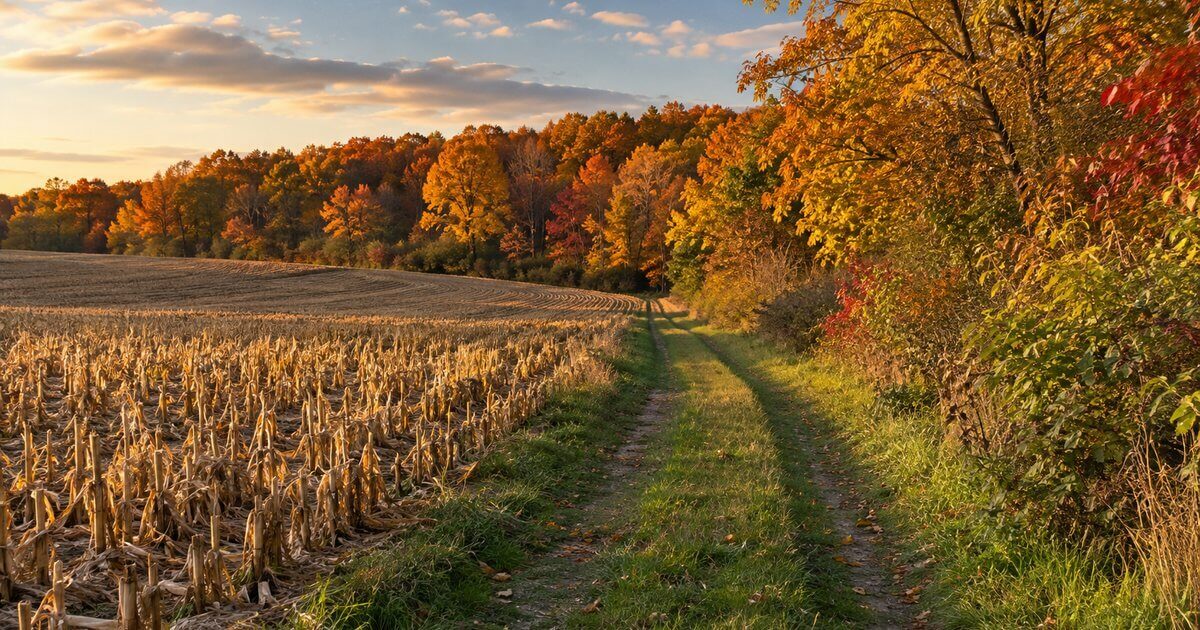
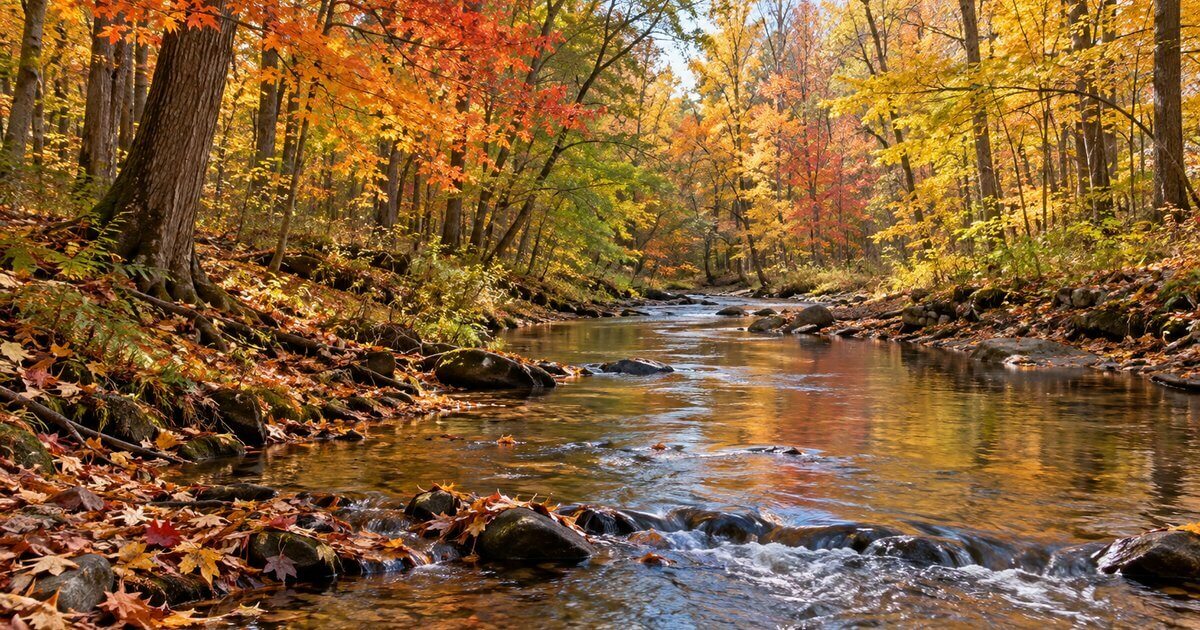 It’s classic farm-country whitetail ground. Picture a small woodlot, a brushy fencerow or two, and fields of standing corn or soybean stubble around them.
Deer density is high. So is hunting pressure, because parcels are small and neighbors are close, and that makes property layout and access more important than raw acreage.
A well-laid-out 40, with a bedding thicket, a food source and an entry route that doesn’t cross the deer, can hunt better than a poorly laid-out 80. With all legal firearms now allowed across the whole Lower Peninsula, shot distance and shooting lanes matter more than they used to.
A few named features are worth knowing before you look. Baw Beese Lake sits just southeast of the city of Hillsdale, and the St. Joseph River that flows to Lake Michigan starts there. The East Branch of the St. Joseph of the Maumee, a designated trout stream, runs through Lost Nation State Game Area. In parts of the county, steep glacial ridges create real terrain funnels.
| By the numbers |
|---|
| 78% forested. That’s the share of Lost Nation State Game Area in forest, with most of the area in mixed upland deciduous cover (Michigan DNR master plan, 2017). |
Public land and access in Hillsdale County
 Lost Nation State Game Area is the county’s main public hunting ground. The DNR’s state game area list puts it at about 2,478 acres, in south-central Hillsdale County near Pittsford and Osseo. You’ll find deer, wild turkey, and cottontail there, along with prairie fens, vernal pools, and steep hardwood ridges.
Public land can push private land value either way. If your parcel sits next to public ground, pressure on the public side can push deer onto you, but expect more trespass risk and more hunters at the line. Farther away, you get less spillover pressure and more control over your own deer.
Neither one wins by default; it comes down to how you plan to hunt. Our guide to evaluating neighbor pressure walks through how to read a parcel’s surroundings.
Find state game areas and public parcels through the DNR’s Where to Hunt page and its Mi-HUNT map.
Who Hillsdale County suits, and who it doesn’t
 Hillsdale fits a few kinds of buyers well.
Drive-time hunters are the obvious ones. Figure roughly 1.5–2 hours from metro Detroit, about an hour or so from Toledo, and a short hop to the Indiana line for Fort Wayne buyers (those are estimates; your start point changes them).
Ag-income buyers like it because tillable acres can be leased while you hunt the timber.
If you want to see deer, you’ll see deer here. Lots of them.
And pilot-county strategists want a property that can produce two bucks starting with the 2027–28 season.
It’s a poor fit if you’re a big-timber hunter looking for thousands of unbroken acres, or if you’d rather not see another orange hat.
If that’s you, head north instead. Otsego and Crawford counties, plus the Upper Peninsula, give you bigger tracts and fewer neighbors.
| From the MWP team |
|---|
| Hillsdale isn’t for everyone. That’s exactly why the buyers it does fit pay attention when the right parcel lists. |
What the 2027 rules change for Hillsdale landowners
Here is how the earn-a-second-buck pilot works in Hillsdale under WCO Amendment No. 7, issued Aug. 12, 2026. Prices below were approved by the Natural Resources Commission (Aug 2026); the DNR hasn’t posted 2027 license fees yet.
- Opt in at license purchase. The EASB package is $40 for residents and nonresidents, $28 for senior residents.
- Harvest an antlerless deer in a pilot county and report it to the DNR.
- Buy the bonus buck tag: $20 for residents, $170 for nonresidents. It’s valid only in the five pilot counties.
- Take a second buck with at least one antler carrying four or more points, each an inch or longer.
At the same time, the rest of the Lower Peninsula drops to one buck per hunter. Hillsdale is one of five places where a hunter willing to shoot does can get back to two.
Before 2027, put your time into three things:
- Build antlerless capacity. Food diversity, doe cover, and multiple low-pressure stand sites.
- Fix access first. If you can only hunt on one wind, you won’t fill antlerless tags.
- Document now. Trail camera archives, harvest records, and dated habitat work give you a record of how the property hunts under the new rules.
Hillsdale’s universal antlerless license use limit is five for the 2026 season (Michigan DNR deer regulations). This season’s doe harvest is good practice for a program where does become the currency.