The first time you see it, you’ll probably laugh—because it’s almost comical.
You pull onto a “solid gravel drive,” ease off the county road, and… the whole thing turns into a smooth, shiny ice runway. Not snow. Not slush. Just that hard, glossy glaze that says, “Hope you didn’t plan on stopping.”
That’s when winter does you a favor. It takes all the land’s little secrets—hidden water movement, soft spots, neighbor patterns, access assumptions—and puts them under a spotlight. Summer can make a lot of properties look good. Winter makes them prove it.
This isn’t a “snow depth and timber visibility” article. This is the problem-finder’s guide: drainage failures, access traps, and neighbor pressure you can actually spot in a Michigan winter—plus what those clues mean, what to ask, and how to use it in your decision-making.
Why Winter Exposes Land Problems Better Than Any Other Season
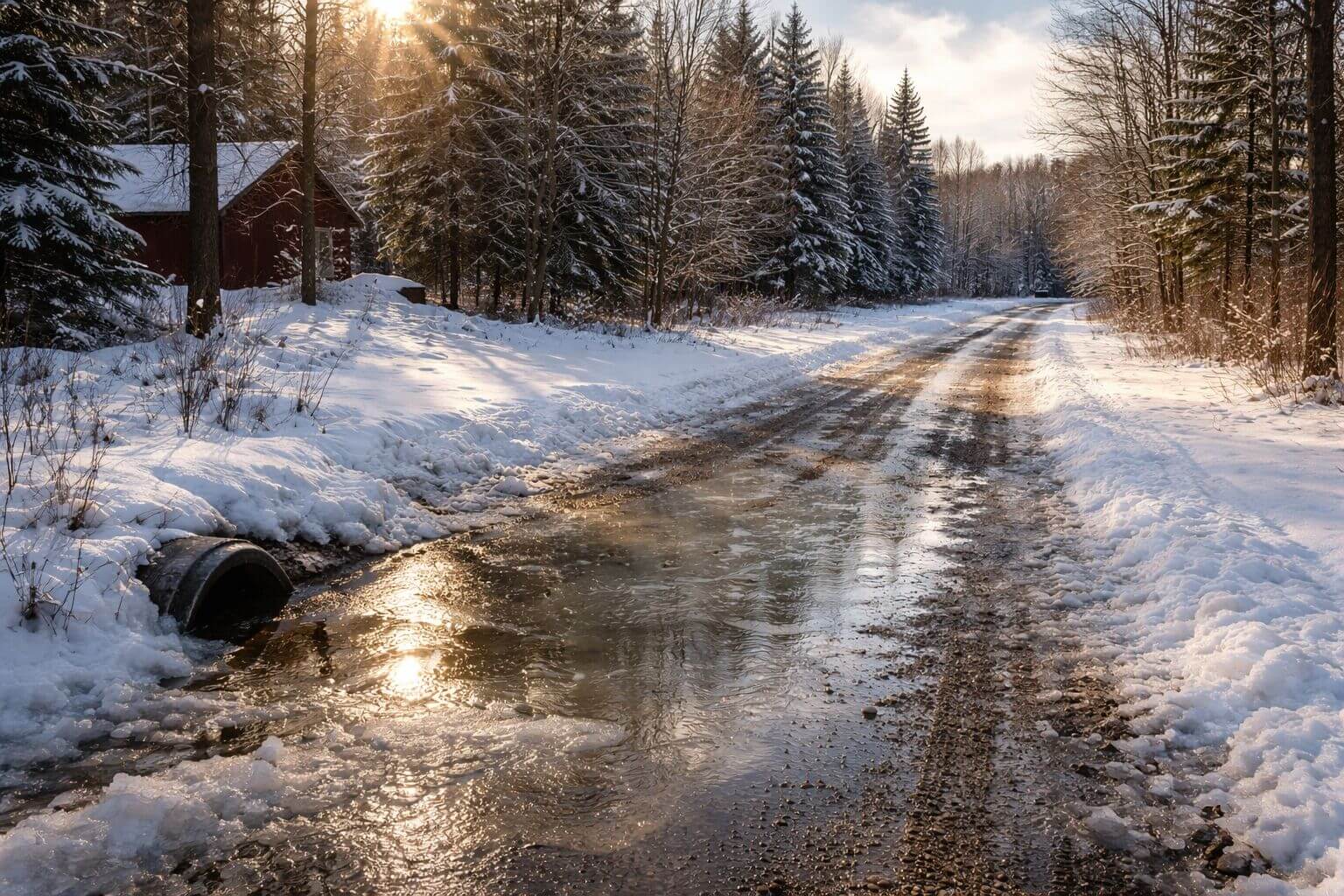 Here’s the simple truth: winter is a stress test.
Freeze/thaw cycles magnify weak road base. Meltwater runs where it wants to run, then locks up overnight. Plows push snow and water into places they don’t belong. If something’s borderline in July, it often becomes obvious in January.
And it’s not just the land.
Winter also reveals people.
Shared drives, private roads, “everyone’s been cool about it” access… all of that gets tested when there’s snow to move and someone needs to get out at 6:30 a.m. for work—or in at 10:00 p.m. after a storm. That’s when you learn whether “neighborly” is a real thing or a marketing phrase.
Drainage Red Flags You Can Spot in Winter (Even When Everything’s Frozen)
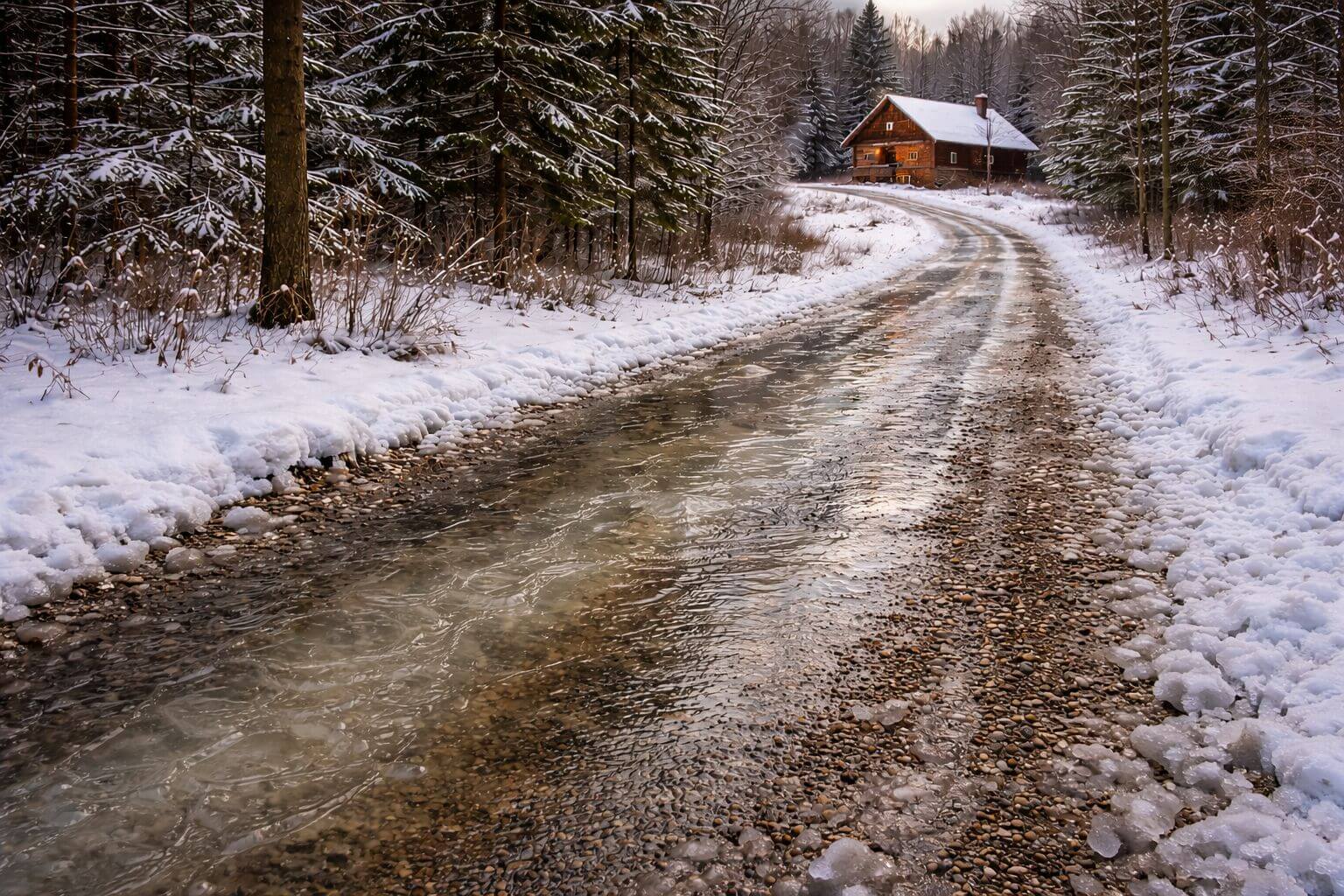 Drainage doesn’t always show up as a swamp. In winter, it shows up as ice, sheen, and refreeze scars.
Ice sheets on drives and two-tracks
If you see an ice sheet on a driveway or two-track, it usually means water is crossing the travel surface—consistently.
That water might be coming from:
-
a hillside seep,
-
a ditch that’s plugged or too shallow,
-
a driveway with no crown,
-
compacted base that won’t shed water,
-
or diverted runoff from neighboring grading/plowing.
A quick on-site trick we use: walk the ice uphill. Ice almost always has an origin story. Find the source, and you’re not guessing anymore.
Culvert problems: small hardware, big consequences
Culverts are one of those things nobody wants to talk about… until they’re standing at the end of a driveway wondering why the truck can’t get through.
In winter, culvert trouble shows up as:
-
an ice plug at the inlet,
-
water backing up like a mini-dam,
-
a new “water path” across the driveway base,
-
overflow that freezes into rutted ice ridges.
Engineering guidance is pretty direct here: ice can clog culverts and cause serious drainage problems during thaw conditions. And when culverts are blocked during high flows, they can contribute to erosion and failure conditions.
Now the part buyers really care about: in many Michigan contexts, driveway culverts are commonly treated as the property owner’s responsibility, and local drainage guidance calls out issues like improper sizing, wrong elevation, clogs, and collapse.
That’s why a winter showing can save you money. A July drive might look “fine.” A January drive shows you whether the system actually works.
Build sites and “snowmelt lakes”
Thinking about a cabin, pole barn, or even a level camper pad?
Then pay attention to where meltwater pauses. A slightly lower pocket can become a seasonal headache—mud in April, soft base in May, and mosquitoes in June.
Watch for:
-
ponding at the bottom of slopes,
-
glossy refreeze zones in shaded areas,
-
darkened snow where water has been flowing underneath.
These are clues, not convictions. But they’re strong clues—strong enough to justify soil checks, site planning, or a smarter building location.
Access Problems Winter Will Tell You the Truth About
 You don’t buy a hunting property to look at it from the road.
Access is everything.
And winter is when “access” stops being a checkbox and becomes a reality check.
Seasonal roads: “frontage” doesn’t always mean winter use
This is a Michigan classic. A listing says “road frontage,” and it’s true. The parcel touches a road.
But is it a year-round maintained road? Or is it seasonal? Or private? Or a two-track that behaves like a seasonal road even if nobody calls it that?
Many Michigan county road commission descriptions of seasonal roads say they are not maintained (including snowplowing) during November through April under the seasonal road system concept.
So if your plan includes late-season hunting weekends, winter getaways, or a future cabin build, you need to confirm:
-
what the road is classified as,
-
what winter maintenance (if any) happens,
-
and who is expected to handle snow removal.
No assumptions. Get it straight.
Plowed-road realities (even when the road is maintained)
Even on maintained roads, snowplow timing matters. Road commissions commonly prioritize main roads first, and local roads can be later.
That might be totally fine for a weekend hunter with flexibility. It might not be fine for someone who wants reliable winter access for guests, rentals, or emergency situations.
One of the most useful “due diligence calls” we can make is simply asking: “How does this road typically look 24 hours after a heavy storm?”
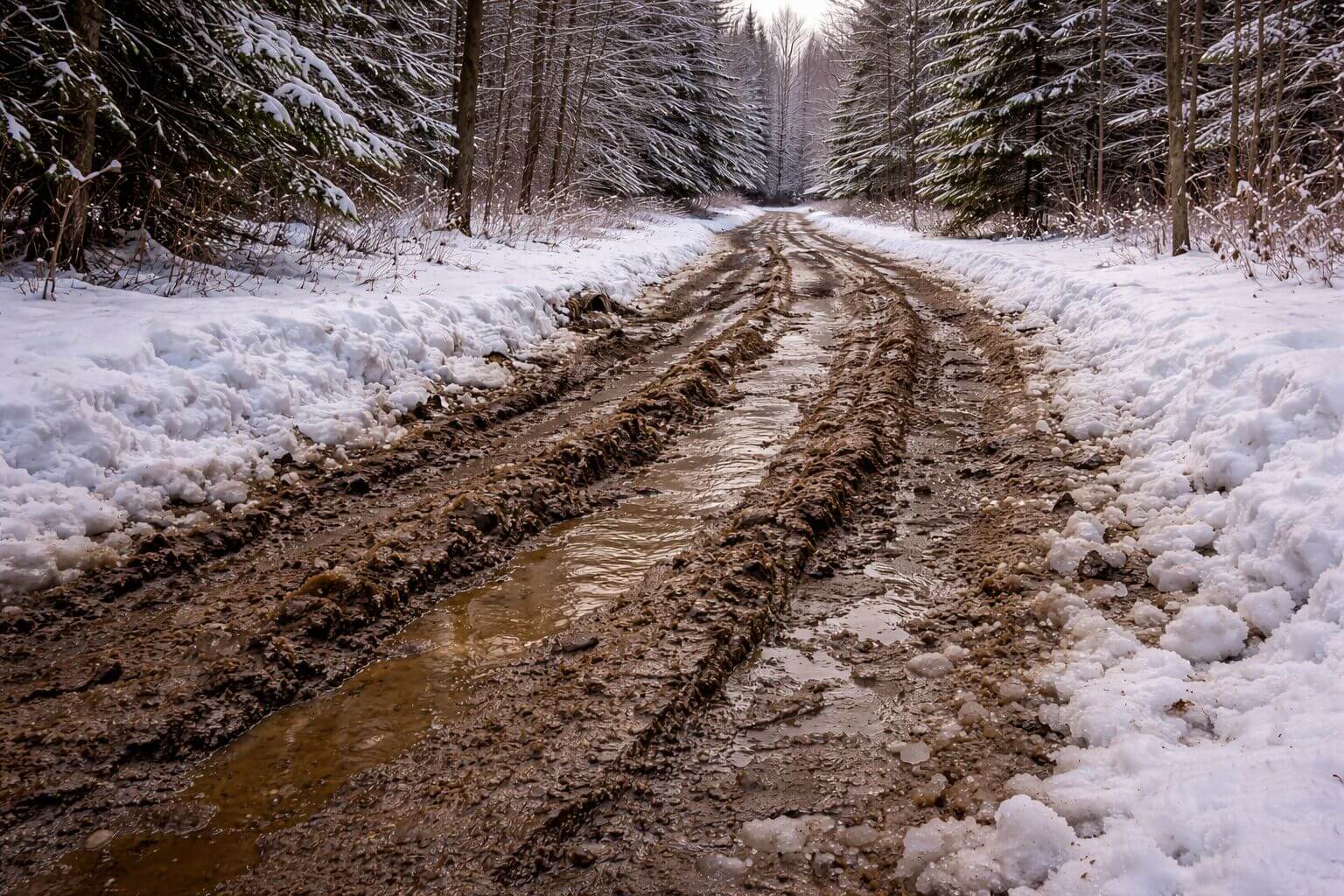
Two-tracks and logging roads: the winter truth serum
A two-track can mean “easy access” or “bring a buddy and a tow strap.”
Winter reveals:
-
soft base hidden under packed snow,
-
cross-slope ice that pushes vehicles sideways,
-
hill sections that turn into slick chutes,
-
spots where water crosses and freezes into ruts.
If you’re serious about buying, walk the route beyond where you can comfortably drive. Your boots will learn things your truck never will.
Shared Drives and Private Roads: Winter Is Where the Drama Leaks Out
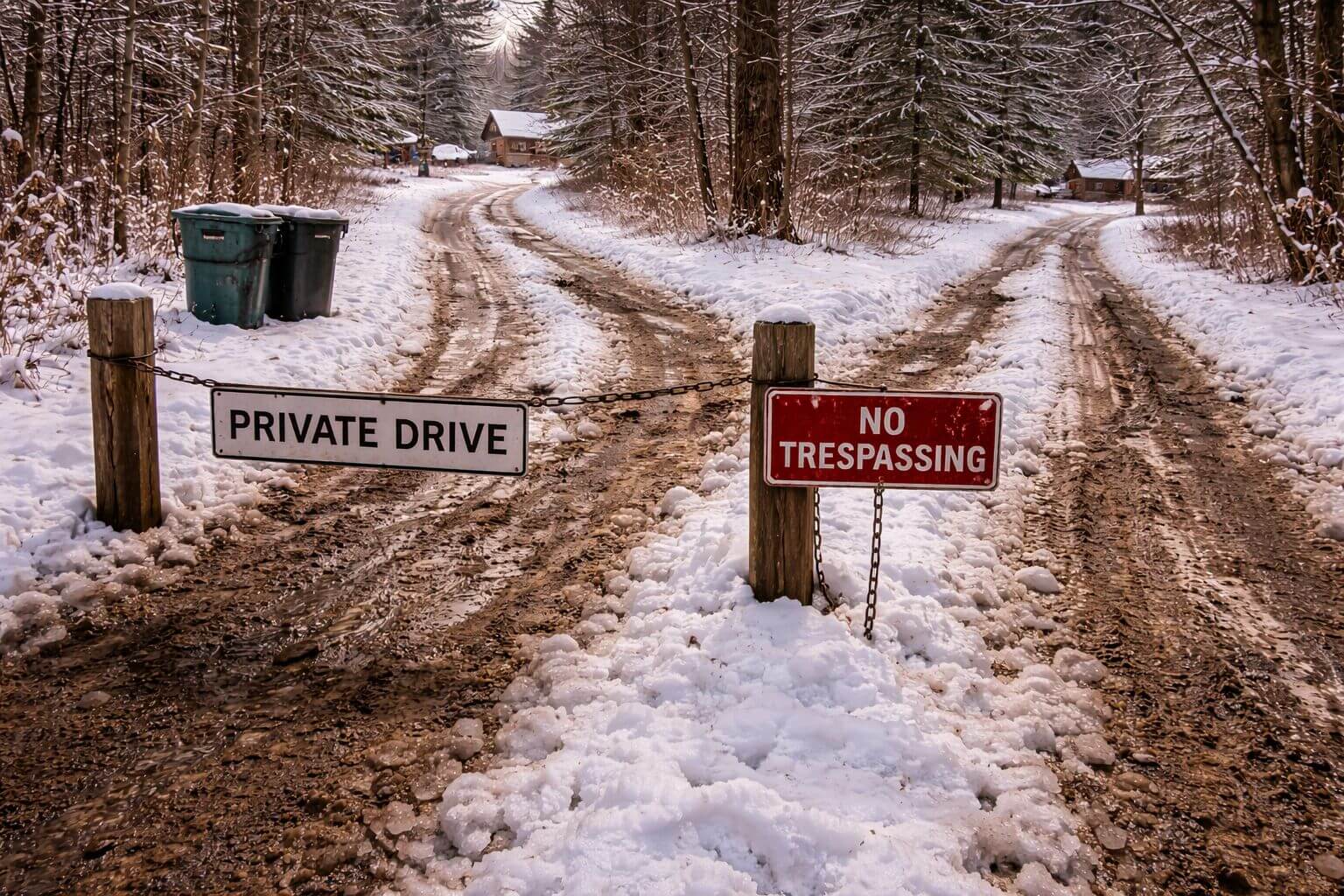 Shared access is common in rural Michigan. It’s not inherently bad. In fact, plenty of shared roads work great—when expectations are clear.
Winter is when unclear expectations show up.
Here’s what to watch for:
-
One party plows; the other doesn’t.
-
Snow is pushed into narrow sections, blocking visibility or creating choke points.
-
Turnarounds get “accidentally” filled in.
-
Tire tracks cut across what looks like “your side” of the drive.
When buyers ask what they should insist on, our answer is boring—but it’s the right answer:
Get it in writing.
Legal resources discussing shared driveway easements consistently highlight maintenance and snow removal as items to spell out, not assume. And Michigan municipalities/townships sometimes provide private road maintenance agreement templates or related guidance—because this becomes a recurring issue when it’s not documented.
A handshake is nice. A recorded agreement is nicer.
Neighbor Pressure: The Winter Clues Most Buyers Miss
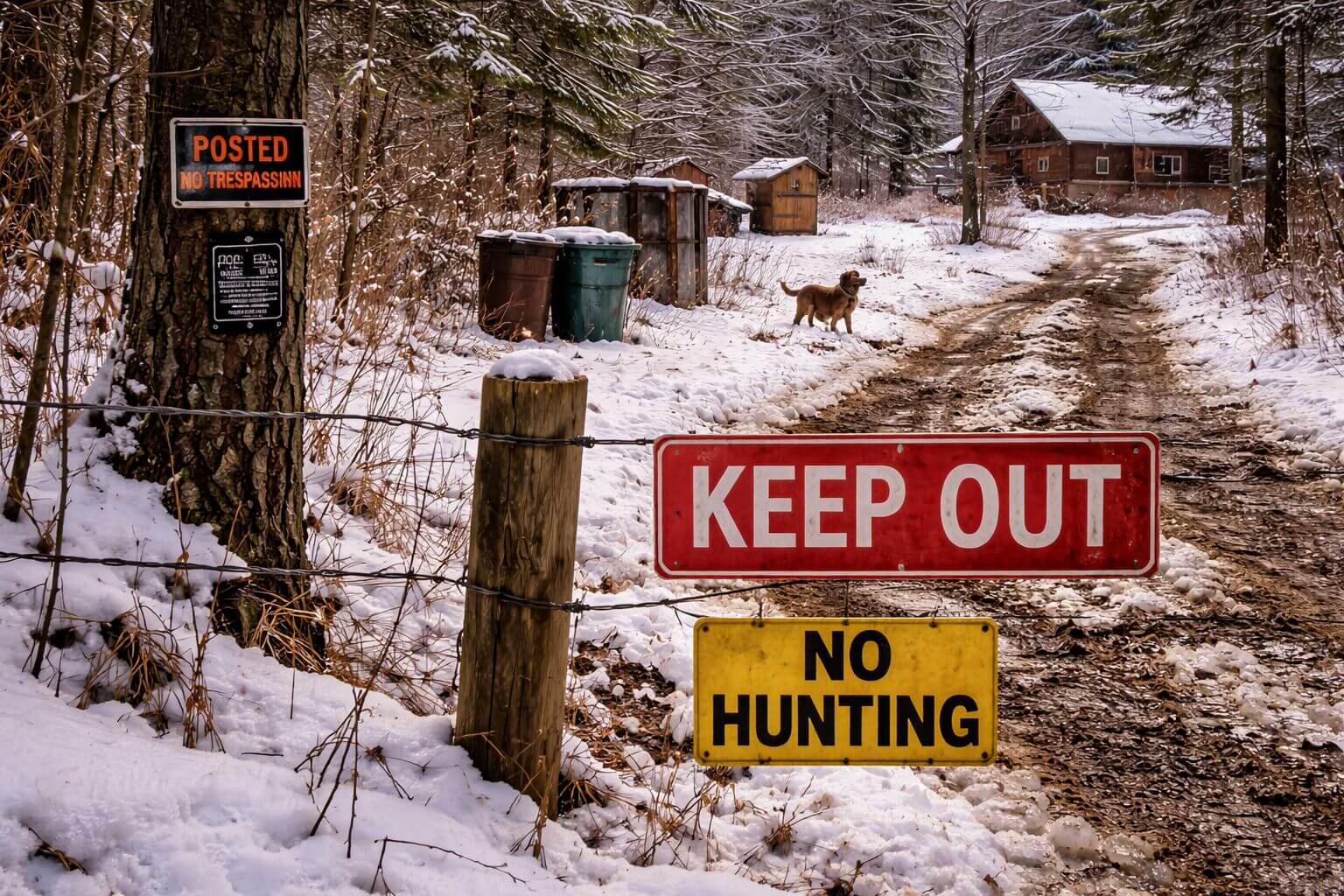 “Neighbor pressure” can sound dramatic, but it usually isn’t dramatic day-to-day. It’s subtle—until it isn’t.
Winter makes it visible.
Boundary behavior becomes easier to see
With leaves down and snow highlighting patterns, you may spot:
-
trails cutting corners,
-
parking habits that creep over the line,
-
stands/blinds suspiciously close to where your map says “mine,”
-
fence lines that don’t match the story.
This doesn’t prove anything legally. What it does is tell you where to:
-
verify lines,
-
request a survey,
-
walk the boundary with GPS mapping,
-
and ask smarter questions.
Access behavior becomes obvious
If your “frontage” is being used as someone else’s turnaround, parking pad, or access lane, winter will show you with tire patterns and plow berm placement.
A practical note from the field: most of these issues are fixable with good communication before you buy—when the seller is still involved and everyone has an incentive to keep things smooth.
The Questions to Ask (Seller, Agent, Road Commission, and Sometimes the Neighbor)
When we’re helping buyers in winter, we’re not trying to “catch” anyone. We’re trying to remove uncertainty. These questions do that.
Access and maintenance
-
Is the road county-maintained year-round, seasonal, or private?
-
If seasonal, what is the winter maintenance expectation (Nov–Apr)?
-
Who plows the driveway approach and any shared road sections?
-
Is there a recorded easement and maintenance agreement for shared access?
Drainage and culverts
-
How many culverts are on the access route, and who maintains them?
-
Any spring washouts, stuck vehicles, or culvert replacements?
-
Any known issues with icing, seepage, or ditching?
Neighbor use and pressure
-
Any shared “permission” arrangements (hunting, access, parking)?
-
Any disputes over water flow, ditching, or snow placement?
Documents to request
-
survey (or recent boundary documentation),
-
easement docs (if access isn’t straightforward frontage),
-
shared driveway/private road agreement,
-
legal description and parcel map.
What These Problems Mean for Price (and How to Negotiate Like a Grown-Up)
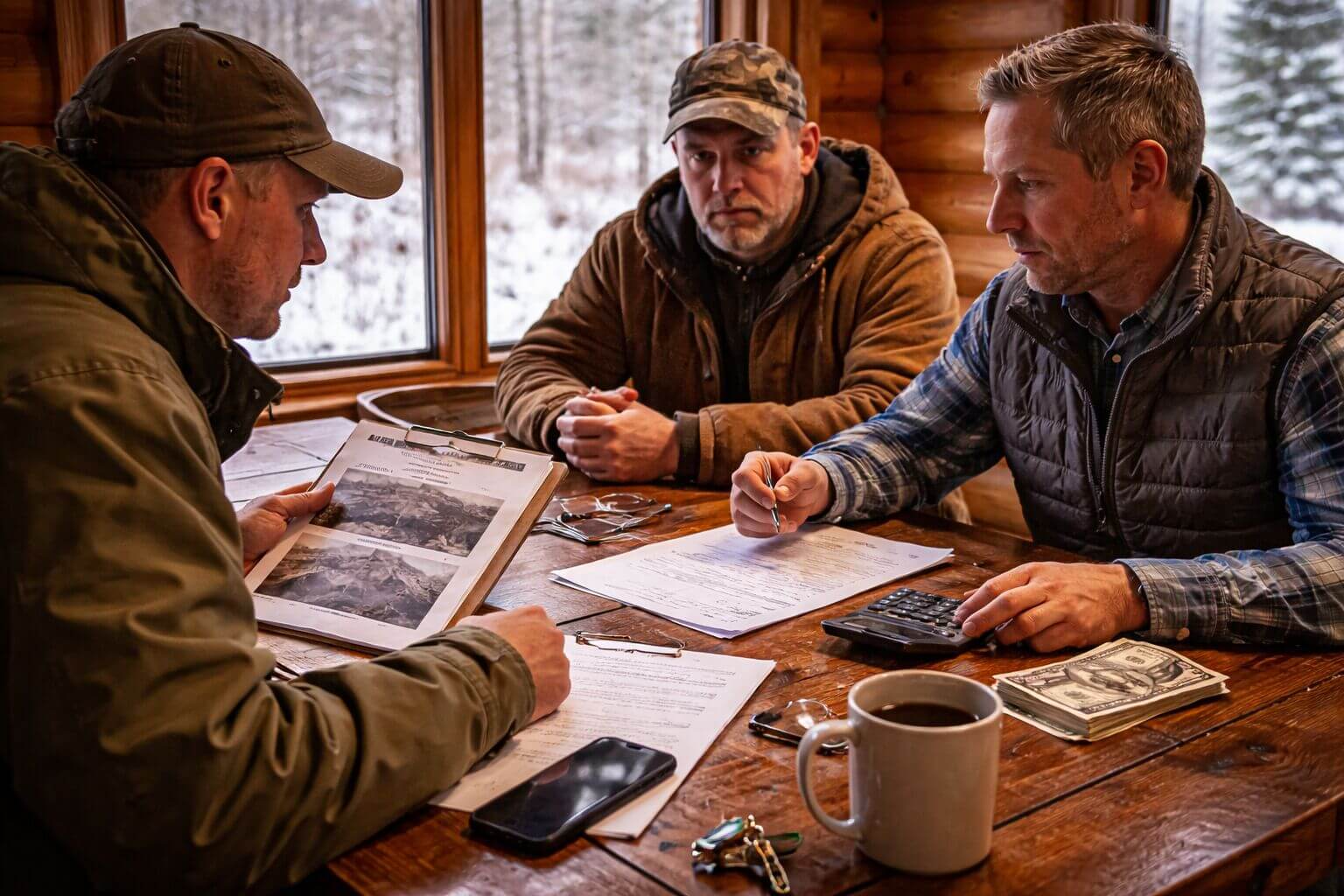 Not every winter issue is a deal-breaker. Some are simply budget items.
Here’s how we categorize them.
Deal-killers (or “price has to move a lot”)
-
Access is not legally defined or relies on informal permission.
-
Seasonal road reality conflicts with your intended use.
-
Chronic drainage threatens access or buildability and can’t be reasonably improved.
-
Shared drive situation is contentious with no written framework.
Fixable issues (and strong negotiation leverage)
-
Replace/resize a driveway culvert.
-
Improve ditching and road crown.
-
Add base/gravel and build a proper turnaround.
-
Formalize shared drive terms with a written agreement.
Negotiation tools that actually get used in real transactions:
-
Seller repair prior to closing (best if time and contractors allow).
-
Price concession.
-
Escrow holdback pending repair completion.
-
Contingencies tied to verifying legal access documents.
Winter findings give you leverage because they’re not theoretical. An ice sheet and a clogged culvert inlet don’t care about anyone’s opinion.
Winter Land Showing Checklist (Michigan Problem-Finder Edition)
Save this. Use it. And don’t be shy about taking photos.
Drainage
✅ Any ice sheets on drive/two-track? Where do they start?
✅ Any visible seep lines crossing the road?
✅ Ditches present? Open or buried?
✅ Count culverts on the route—are inlets/outlets visible?
✅ Signs of damming/backup (ice buildup, overtopping, wash lines)?
✅ Low spots near build areas showing ponding or refreeze?
Access
✅ County-maintained, seasonal, private, or two-track?
✅ If seasonal: what’s the true winter maintenance expectation (Nov–Apr)?
✅ Safe turnaround for truck/trailer?
✅ Steep grades or sidehills that will ice up?
✅ Gates/chains/informal blockages?
Neighbor pressure
✅ Tire tracks using your frontage/turnaround?
✅ Trails cutting corners near boundary areas?
✅ Evidence of shared use not documented?
✅ Snow placement that creates conflict points?
Documents
✅ Survey/boundary map
✅ Easement(s) and legal access description
✅ Shared drive/private road maintenance agreement
✅ Any notes/records on culvert responsibility and prior repairs
FAQs (Helpful for readers + SEO)
Is winter really the best time to inspect land in Michigan?
If your goal is to spot problems, yes. Winter reveals access limitations, freeze/thaw drainage failures, culvert issues, and neighbor-use patterns that summer can hide.
What does an icy driveway usually mean?
Typically, it means water is moving across the travel surface—seepage, poor crown, inadequate ditching, or a culvert/ditch that isn’t functioning.
Who is responsible for a driveway culvert in Michigan?
Many local guidance sources treat driveway culverts as the property owner’s responsibility, and they outline common culvert problems like clogs, poor sizing, and collapse.
Always confirm locally for your specific county and road right-of-way.
Are seasonal roads plowed in Michigan?
Seasonal road guidance commonly describes them as not maintained/snowplowed November through April under the seasonal road system concept.
Call the county road commission to verify the exact road.
What should we demand for a shared driveway before buying?
A recorded easement and a written maintenance agreement that spells out costs, repairs, and snow removal expectations.
Conclusion: Winter Doesn’t Lie—Use It
If you only tour land on a bluebird June day, you might miss the stuff that matters most when you actually own it: getting in, staying in, and keeping peace with the neighbors.
Winter is when you find out:
-
where water really goes,
-
whether access is dependable or “depends,”
-
and whether shared roads come with shared expectations—or shared headaches.
If you’re looking at one of our Michigan hunting or recreational lands right now and want a second set of eyes on drainage, access, and neighbor pressure, reach out. We’d rather help you spot a problem before you buy it than help you fix it after.