 Michigan hunting land due diligence is the 30-to-45-day verification window between your accepted offer and the closing table, and it should cover 15 specific checks before you sign. Unlike a subdivision house, a hunting parcel can hide problems no inspection report catches: severed mineral rights, unrecorded access, regulated wetlands under Part 303 of Michigan’s Natural Resources and Environmental Protection Act, or a Qualified Forest Program enrollment that triggers back taxes if it isn’t transferred correctly. Michigan sets no statutory due diligence period — whatever timeline is written into your purchase agreement is the one you’re bound by, so negotiate enough time to verify everything. Michigan Whitetail Properties has guided buyers through this process since 1995, and the checklist below reflects what 30 years of Michigan land closings across all 83 counties have taught us actually goes wrong.
A buyer once called us about a 40 in the Upper Peninsula he’d nearly purchased through a for-sale-by-owner deal. Great timber, good deer sign, fair price. One problem: the only access was a two-track crossing the neighbor’s property, and nothing about that crossing appeared in the deed. No recorded easement. No legal access at all. He’d have owned 40 acres he could only reach by trespassing. That deal died in due diligence — which is exactly where bad deals are supposed to die.
The Full 15-Point Checklist at a Glance
Every item below deserves attention on every hunting land purchase, even when the parcel looks clean. Here’s the complete list before we break down why each one matters.
| # | Verification Item | Where It Gets Checked |
| 1 | Boundary walk against the deed | On the ground, with deed in hand |
| 2 | Title search and title insurance review | Title company |
| 3 | Legal access and road status | Register of Deeds, county road commission |
| 4 | Mineral rights status | Deed chain, county records |
| 5 | Oil and gas lease status | Register of Deeds |
| 6 | Deed restrictions and easements | Title commitment |
| 7 | Wetland review | EGLE wetland inventory maps |
| 8 | Flood zone check | FEMA flood maps |
| 9 | Timber cruise | Consulting forester |
| 10 | QFP or CFP enrollment and transfer eligibility | MDARD / DNR |
| 11 | Property tax status and uncapping estimate | Township assessor |
| 12 | Zoning classification | Township or county zoning office |
| 13 | Lake or stream frontage regulations | DNR / EGLE |
| 14 | Utility availability | Utility providers |
| 15 | Well and septic inspection (if structures exist) | County health department |
Ground-Truth the Property Itself (Items 1, 7, 8, 9)
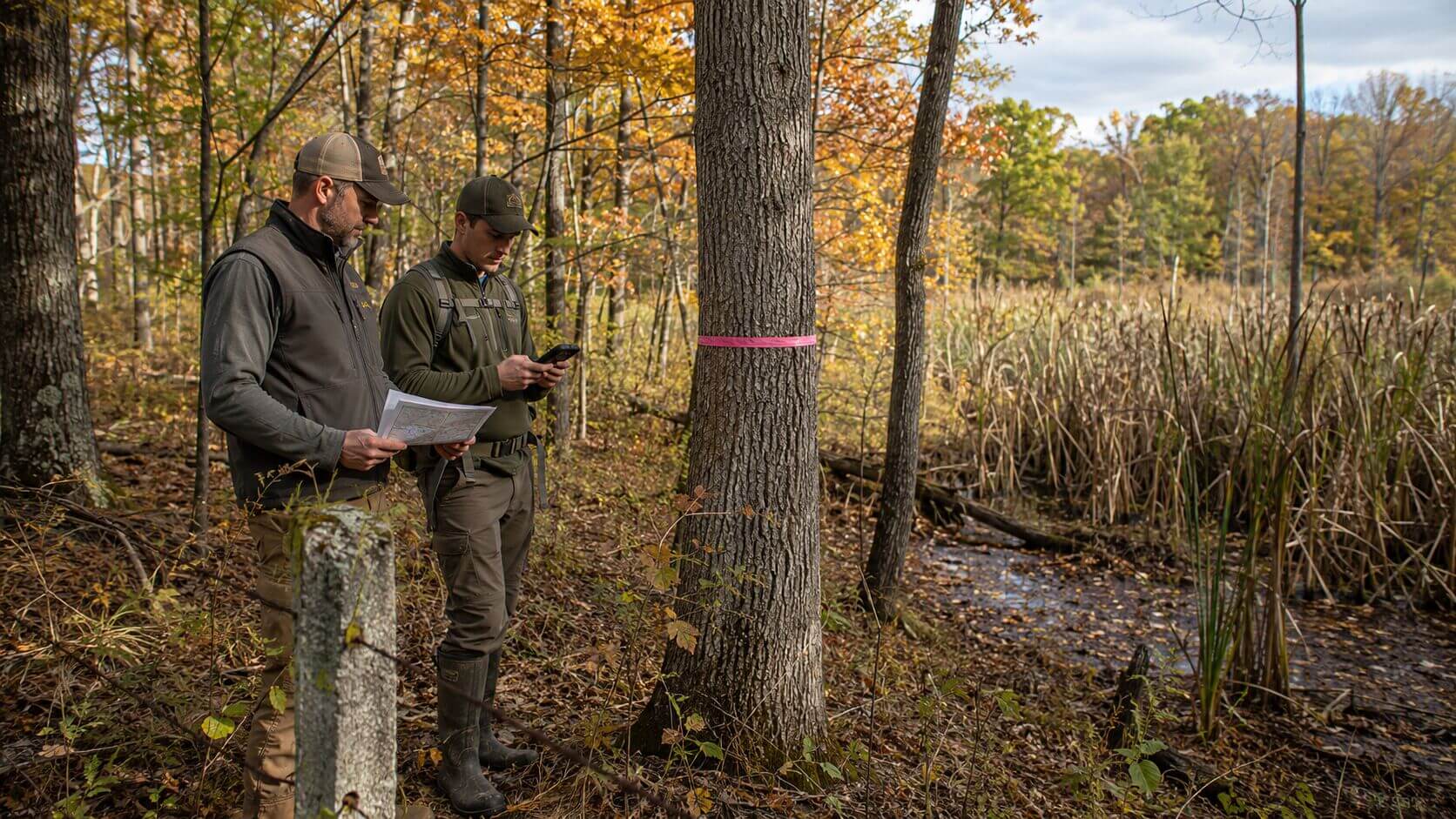 Start with your boots. Walk every boundary line with the deed description and a mapping app, matching corner markers and old fence lines against what’s on paper. Fences in Michigan farm country wander — a fence line 30 feet inside the true boundary is common, and you want to know which side of that discrepancy you’re buying.
Then check the water. Per Michigan EGLE, activities in regulated wetlands — filling, dredging, building — require a permit under Part 303 of the Natural Resources and Environmental Protection Act, 1994 PA 451. Wetlands make tremendous deer bedding cover, so they’re often an asset on hunting ground. But if your plans include a cabin site, a pond, or new trail crossings, review EGLE’s wetland inventory maps now, not after closing. Pull the FEMA flood map for the parcel at the same time.
If the property carries merchantable timber, hire a consulting forester for a cruise. A 40-acre stand of mature red oak can add $40,000 or more to a property’s real value — and a stand that was high-graded three years before listing can subtract just as much while still photographing beautifully in September.
Confirm What You’re Actually Buying (Items 2, 3, 4, 5, 6)
Title work is where hunting land deals get saved or sunk. A title search takes one to two weeks and surfaces liens, encumbrances, and claims against the property, and the title commitment lists every recorded easement and deed restriction. Read that exceptions page line by line.
Mineral rights deserve their own paragraph. In Michigan, mineral rights can be severed from surface rights and sold or retained separately — and according to the Michigan DNR, severed mineral ownership is widespread across the state. Under Michigan’s Act 42 of 1963, severed oil or gas rights revert to the surface owner after 20 years of dormancy, but only if none of five preserving actions occurred, so don’t assume old reservations are dead. Check the chain of title, and check for active oil and gas leases while you’re at it.
And verify access in writing. Legal access means a recorded easement or frontage on a public road — not a handshake with the current neighbor. The neighbor who waves you through today can sell to someone who won’t tomorrow.
Protect the Tax Picture (Items 10, 11, 12)
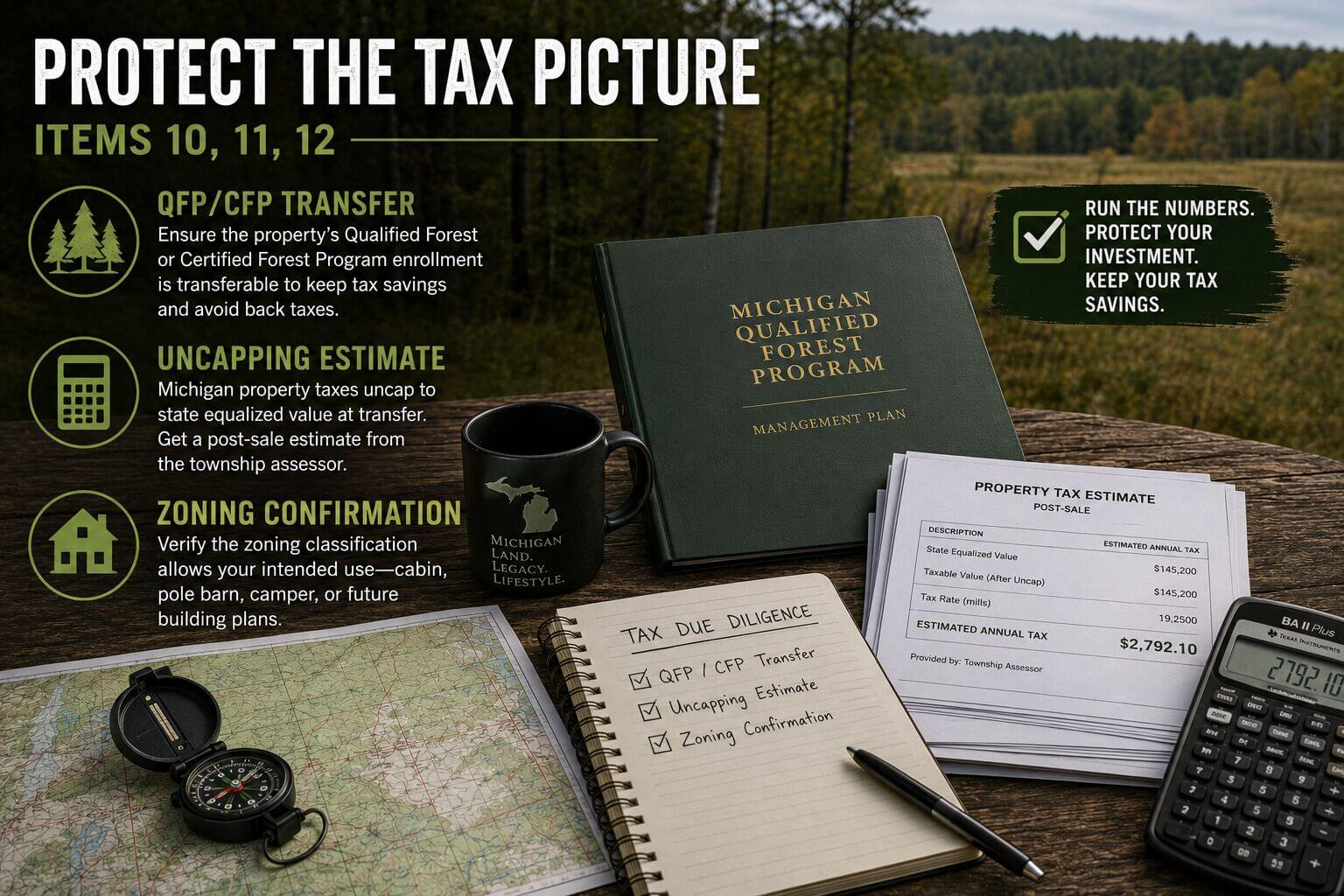 Michigan land taxes can swing hundreds of dollars per month based on program enrollment and uncapping, so run these numbers before you commit.
- QFP/CFP transfer. If the parcel is enrolled in the Qualified Forest Program, MDARD requires the new owner to submit a transfer application with the executed deed and the forest management plan, plus file a taxable value affidavit with the Register of Deeds. Done right, the transfer keeps the taxable value from uncapping. Done wrong or ignored, you lose the exemption. Our breakdown of how QFP tax savings work, deadlines, and common mistakes covers the details, and our CFP vs. QFP comparison explains which program fits which property.
- Uncapping estimate. Michigan property taxes uncap to the state equalized value at transfer. Ask the township assessor for a post-sale estimate — the seller’s tax bill is not your tax bill.
- Zoning. Confirm the classification allows what you’re planning: a pole barn, a camper parked for deer season, an eventual cabin. Township rules vary widely.
Cover the Practical Details (Items 13, 14, 15)
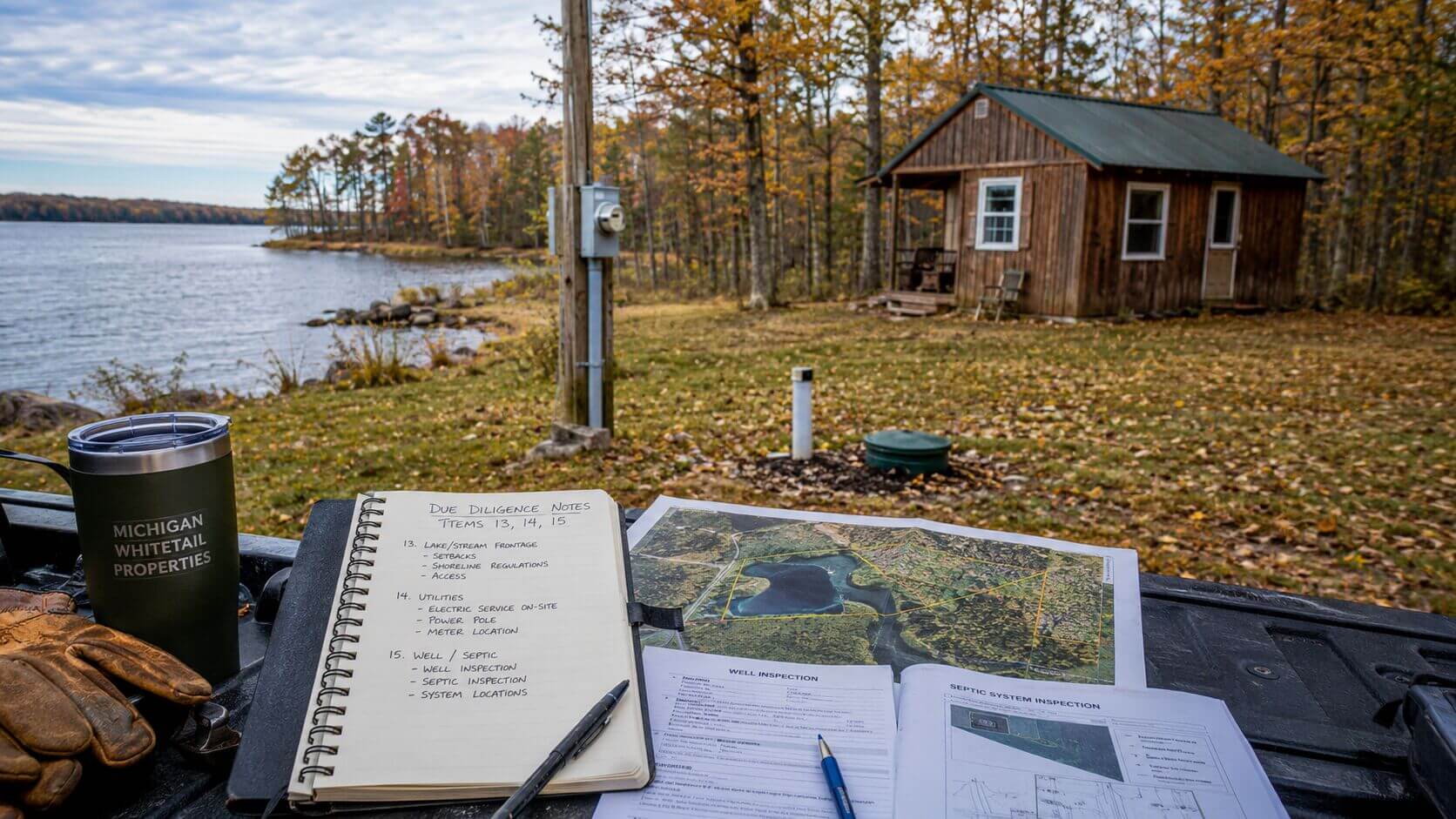 Water frontage brings DNR and EGLE rules on docks, shoreline work, and bottomland ownership, so review them if your parcel touches a lake or stream. Confirm electric service distance if you ever want power — a quarter-mile of new line can cost $10,000 or more. And if the property includes a cabin or house, get the well and septic inspected through the county health department; a failed septic system is a five-figure surprise.
None of this should scare you off. It should slow you down for 30 productive days. Buyers who work this checklist close with confidence, and buyers who skip it become the cautionary stories agents tell. If you’re earlier in the journey, our guide to the process to buying land maps the full path from search to closing, and our article on why fall is a smart time to buy explains how this checklist fits a September-to-November timeline. Ready to look at ground? Browse current hunting land listings across Michigan.