 Timber value Michigan hunting land is a real, quantifiable asset that buyers consistently underprice — and sellers rarely volunteer to explain. A forested Michigan hunting property carries an average of around $3,300 per acre for timberland, but the standing timber on a single 80-acre parcel can easily represent $40,000 to $100,000 in harvestable wood value that won’t appear anywhere in the listing price. Michigan Whitetail Properties has been evaluating forested properties across all 83 Michigan counties since 1995, and the pattern repeats constantly: buyers focus on price per acre and overlook the forest. White oak currently commands $475 to $750 per thousand board feet (MBF) at stumpage in northern Michigan markets. Red oak runs around $300 to $400 per MBF. Hard maple and black cherry sit between $150 and $400 per MBF depending on grade and log quality. An 80-acre property with 20 productive acres of mature white oak and hard maple can carry $60,000 to $80,000 in timber value. That’s not a bonus. That’s leverage you need to understand before you make an offer.
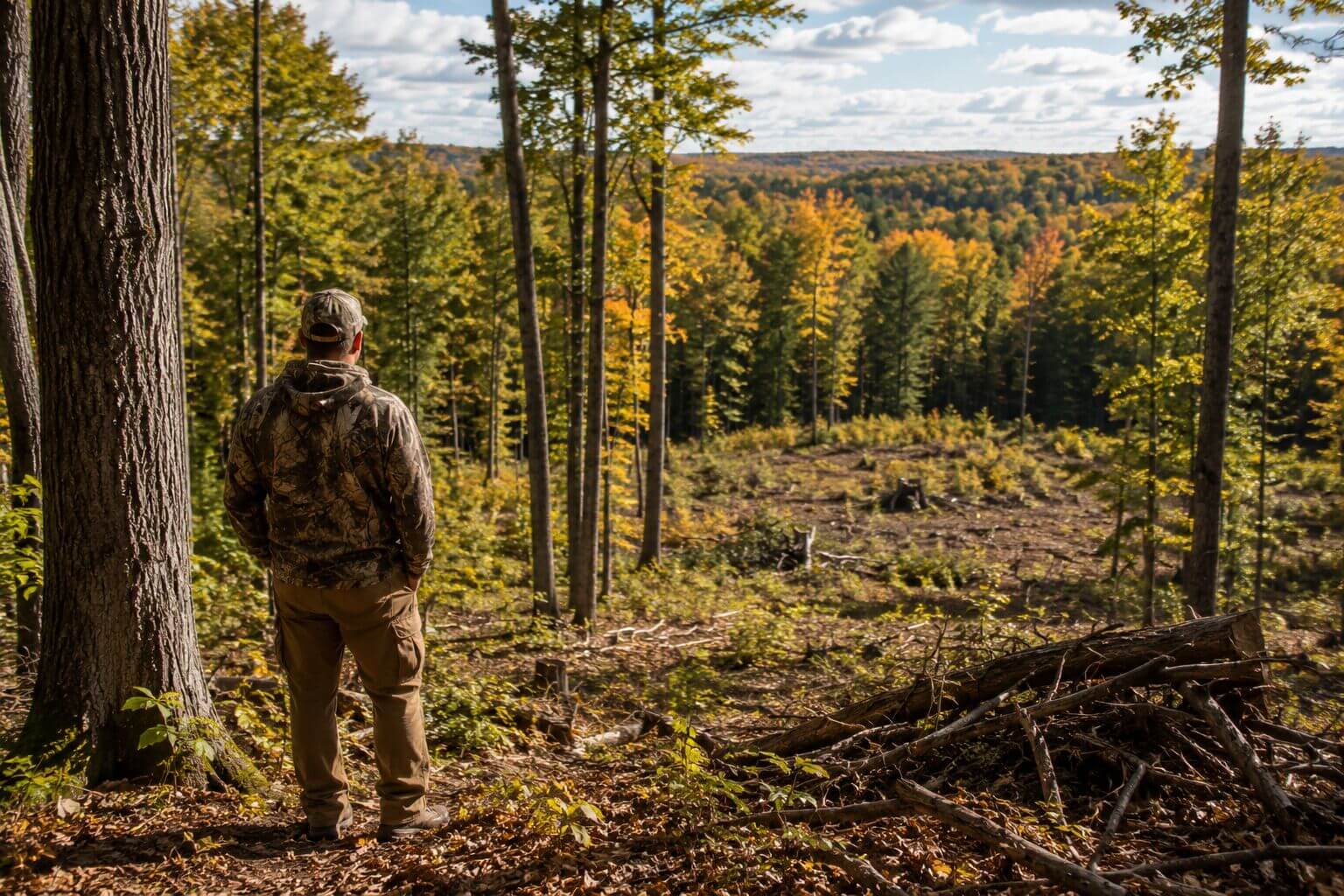
Picture this: you’re walking a 120-acre parcel in Oscoda County. The broker is pointing out the food plot potential in a back field. You’re nodding along, already calculating stand sites in your head. But behind that field — on a gradual north-facing slope — there’s 60 acres of mature mixed hardwoods. Big-diameter red oak. A scattering of white oak, easily 18 to 22 inches at the base. Hard maple in the understory that somebody’s clearly let grow.
Two years later, the seller hires a forester and harvests $55,000 in timber you already paid for.
It happens. It doesn’t have to.
Michigan Timber Species and What They’re Actually Worth
Not all trees are equal in Michigan’s lumber markets. Species composition tells you almost everything about a property’s timber potential per acre. Michigan DNR quarterly stumpage reports track prices across the state’s timber sales, and the spreads between species are significant.
The table below reflects current market values based on Michigan DNR Q4 2025 stumpage data and active 2026 market conditions:
| Species | Stumpage Price (per MBF) | Notes |
|---|---|---|
| White Oak | $475–$750 | Premium grade; high demand for flooring and furniture |
| Red Oak | $300–$400 | Solid demand; volume species in NLP forests |
| Hard Maple | $200–$400 | Quality-dependent; higher grades command premium |
| Black Cherry | $150–$300 | Strong craft and furniture market; size-dependent |
| Soft Maple | $50–$150 | Low individual value; common companion to cherry/maple |
| Aspen | $20–$60 | Pulpwood grade; low per-tree value but often found in volume |
Crawford, Oscoda, Roscommon, and Montmorency counties carry significant concentrations of these high-value hardwoods. If you’re looking at forested properties in these areas, timber deserves its own line of analysis.
How to Read a Timber Stand During Your Property Walk
You don’t need a forestry degree to spot value. You need to know what to look for and what questions to ask before your offer goes in.
Here’s a practical field evaluation process any buyer can use:
- Count the big trees. Walk a rough grid and note how many trees exceed 12 inches in diameter at chest height (DBH). Merchantable hardwoods in Michigan typically start at 12″ DBH. More large-diameter trees per acre means more board feet per acre.
- Identify the dominant species. A stand of mostly aspen and tag alder carries modest timber value. If you’re walking through large-diameter red oak, white oak, or hard maple, you’ve got something worth quantifying.
- Read the forest floor. Heavy slash piles — cut tops and limbs left on the ground — are evidence of a recent harvest. Rotted stumps mean it happened years ago and the stand has had time to recover. Fresh stumps are a red flag: someone may have harvested just before listing.
- Check the canopy layer. Healthy timber stands have a layered canopy. If you see only thin-diameter saplings with bright light flooding through the top, the stand has likely been high-graded.
- Assess equipment access. Timber with no practical way to extract it is worth far less on paper. Seasonal wetlands, steep terrain, and no established trails all reduce real-world timber value even when the species and volume are there.
This won’t produce a certified number. But it’ll tell you whether the timber is worth investing in a professional evaluation before your offer is accepted.
Red Flags: Signs That Timber Value Has Already Left the Property
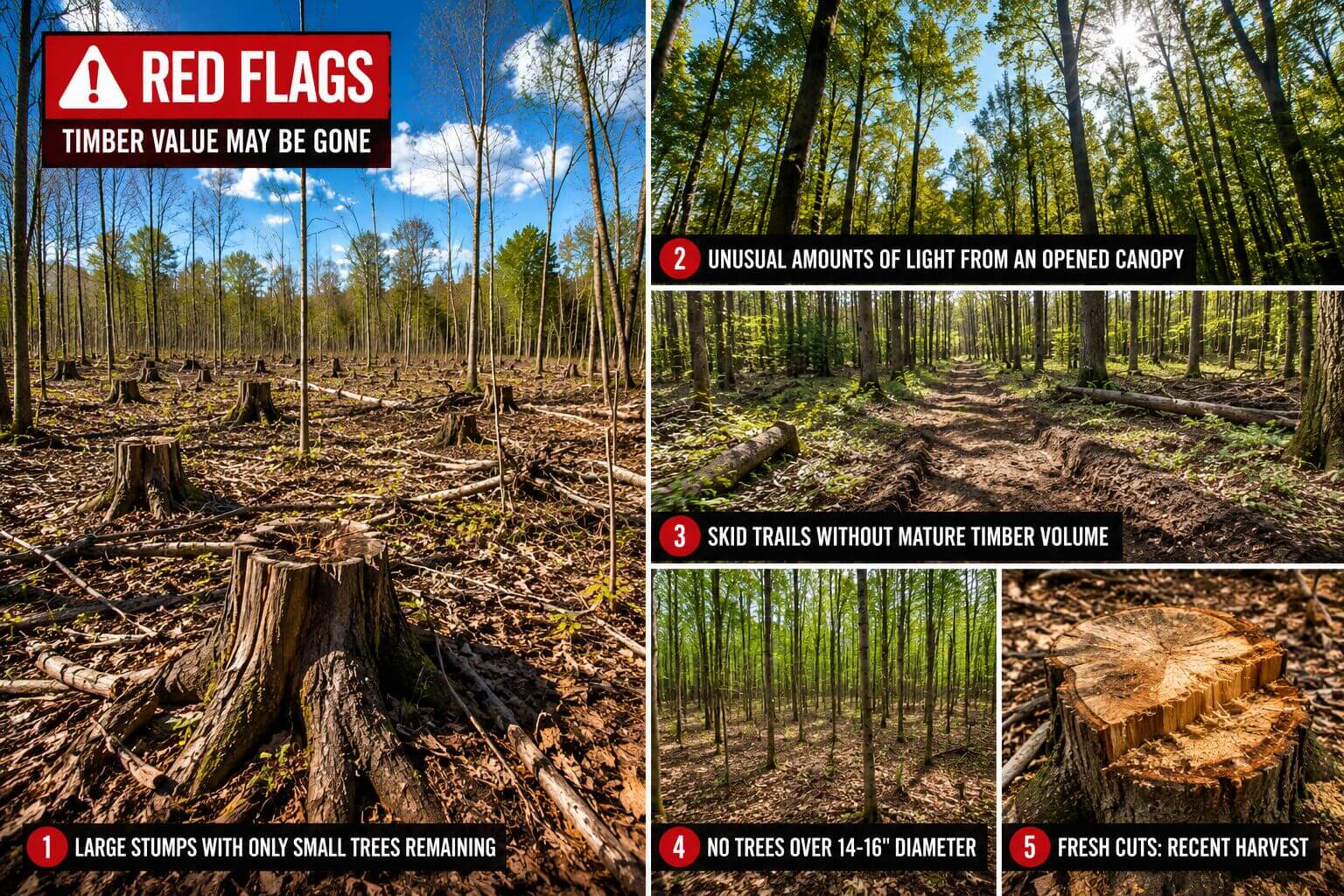 High-grading is the most common way Michigan land buyers lose timber value without knowing it. High-grading means a previous owner — or a timber buyer with a cutting agreement — selectively removed only the largest, most valuable trees. What remains looks like a forest. It has trees. The best ones just aren’t there anymore.
Watch for:
- Large stumps surrounded by only small-diameter young trees
- No trees over 14–16 inches in stands that should carry mature hardwood
- Unusual amounts of light reaching the forest floor from an opened canopy
- Visible skid trails without corresponding mature timber volume in the stand
Timber Stand Improvement (TSI) neglect is a different but related issue. TSI involves removing invasive shrubs, low-value wolf trees, and competing vegetation to release mast-producing trees like oak. Per Michigan DNR forestry guidance, properties without documented TSI history often have oak and other mast trees suppressed by dense undergrowth — reducing both timber value and deer habitat quality simultaneously.
Both are negotiating points, not necessarily deal-breakers. But you need to know what you’re buying.
Should You Get a Timber Cruise Before Closing?
A timber cruise is a professional forest inventory. A registered consulting forester walks the property in a systematic grid, tallies each merchantable tree by species and diameter class, and calculates total volume and estimated stumpage value. The result is a cruise report — a defensible number, not an estimate.
Cost runs $300 to $800 for a typical Michigan hunting parcel in the 40- to 80-acre range. Larger properties with complex terrain can run $1,200 to $2,000+. Per MSU Extension’s guide on hiring consulting foresters in Michigan, the state has a network of registered professionals available for pre-purchase assessments.
Here’s a simple rule: if you’re buying a forested property over $200,000, or any property with significant visible hardwood volume on 40+ acres, get the cruise. A $400 fee against a potential $60,000 timber asset is the easiest math in the purchase process.
The cruise serves a second purpose: it establishes your baseline for Qualified Forest Program (QFP) enrollment, which can reduce your annual property taxes significantly once you own the land. Timber management is one of QFP’s core eligibility criteria.
Timber Value and the Asking Price: Where Does It Fit?
Buyers ask this regularly: if the timber is worth $60,000, is that already priced into the ask?
Sometimes yes, sometimes no — it depends on how well the seller (and their agent) understand what they’re selling. Properties listed through residential agents with no land experience often have timber value that’s never been quantified. The listing reflects comparable sales, which may or may not include timber-heavy properties. That’s where informed buyers have an edge.
A timber cruise gives you data. Data wins negotiations. For a longer look at how Michigan timber generates ongoing income and return on investment, our Michigan timberland investment guide and sustainable timber harvesting overview cover how managed harvests work on properties you plan to hold long-term.